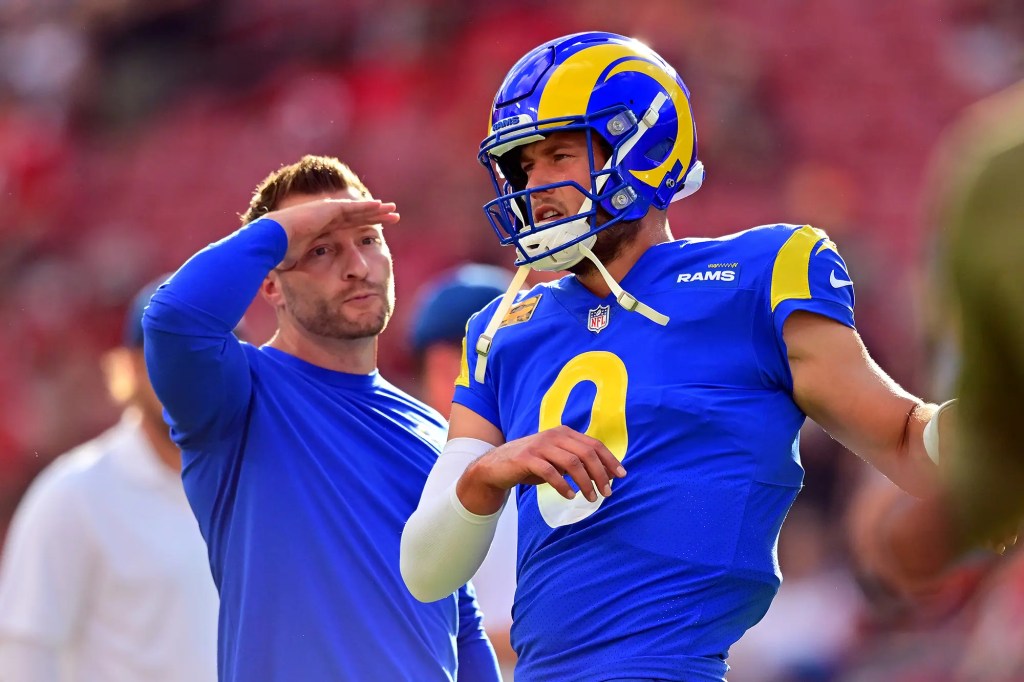
Trailing by a mere point with 5:53 remaining in the 4th quarter, Matthew Stafford connected with backup RB Ronnie Rivers in the flat, a fifteen yard gain setting up a first down at the Detroit Lions’ 40 yard line. By all accounts, the Rams were in the driver’s seat, needing only a few more yards to enter Brett Maher’s range for a go-ahead field goal attempt. They take the full 40 seconds afforded to them by the play clock before snapping it, whereafter Stafford’s pass in the chest of Tyler Higbee is derailed by a vicious hit, falling incomplete. The second down attempt is secured over the middle by Cooper Kupp for a gain of six yards, and again the Rams allow 40 irretrievable seconds to dissipate. Suddenly it’s third down, and a botched protection forces Stafford to dump the ball off to Rivers, who is swarmed by Lions defenders for a loss of two. Worse yet, lineman Rob Havenstein is flagged for holding on the play, a penalty which the Lions elect to enforce, the 3rd and 14 attempt falls controversially incomplete as players beseech the official for a pass interference call, and when the dust settles it is 4th and 14 at the 44 yard line. Too far to attempt a field goal, facing vanishingly slim odds of converting a first down, Coach McVay opts to punt the football back to Detroit. Announcers Mike Tirico and Cris Collinsworth commend this decision as “trusting his defense.”
Tirico mentions as an afterthought that the Rams have one timeout, but his cadence buries it and the fact suffers an ignoble death, suffocated by procedural formality, its magnitude lost on a spellbound audience of 35 million.
Four plays later, the game is over, and the Rams have lost. The Lions converted two first downs and drained the final 4:07 off the clock. Perfervid euphoria consumes everything, and rightfully so: Detroit fans have had it rough lately. The Detroit Pistons are on pace to finish with the worst regular season record in the history of the NBA, the Tigers own the longest active postseason drought of all teams in the MLB, and the Lions hadn’t won a playoff game since the George H.W. Bush administration. Still, when the camera pans to reveal a pandemic of dumbfounded devastation ravaging the Rams’ sideline, we are left with the same question as they are: Where did it all go wrong?
Issue #1: Why did the Rams only have one timeout remaining?
To understand why this is such a problem, it must first be established that timeouts are an exceedingly significant variable in the outcome of close games. There is extensive data on the subject, which I will link below, but I want to try and help with the intuitive understanding of this fact.
Football games are significantly shorter than they seem. This owes entirely to the slothful 40 second play clock, and forgive me because we are going to do a bit of math. An NFL game is 60 minutes long, or 3600 seconds. An average play takes 5 seconds. Assuming for the sake of this exercise that a team simply ran the ball up the middle on every play and then burned all 40 seconds of the play clock, the game would last 80 total plays. (3600/45=80)
Compare this to the NBA, a game which is ostensibly 12 minutes shorter (48 total) but has a 24 second play clock. Approached analogously, where teams always burn the full shot clock before shooting, the game would last 120 total plays. (2880/24 = 120)
In practice, the numbers remain stunning. The average number of total possessions in a 2023-2024 NBA game is two hundred and six. 206. Rams-Lions featured just 110 total plays. Discounting the throwaway plays at the end of the first half (in which the Rams did not have sufficient time to attempt a drive), Los Angeles possessed the ball just seven times all game. They ran 55 plays over 30:05, averaging 33 seconds per play despite trailing the whole game and attempting to pass on 70% of their snaps. Throw out the incompletions, and the average approaches 39 seconds per play. Using our 5-6 seconds per play estimate, we realize that the plays themselves only account for about 9 or 10 minutes of total game clock, while the remaining 51 minutes are devoured in an abyss of mechanical organization and gamesmanship.
Late game scenarios represent the apex of such time manipulation. Talented offenses can orchestrate scoring drives in as little as 30 seconds or as long as 10 minutes. The stated time on the scoreboard has far less bearing on the outcome of close games than does the question of who possessed the ball last. To this end, the value of a timeout cannot be overstated.
Last season’s Week 1 matchup between the Falcons and Saints is an instructive, straightforward example of this. The Falcons led 26-24 and possessed the ball at midfield with 1:50 left to play. In the absence of timeouts, the Falcons would run three harmless plays (kneel downs), burn 40 seconds between each of them, and walk away with a victory. The Falcons win probability in that scenario is effectively 100%. Unfortunately for the Falcons, the Saints had preserved all three of their timeouts. The Falcons ran three plays, totaling 9 yards, and the Saints used three timeouts, limiting the damage to just 18 seconds. The Falcons faced 4th down, and thus punted the ball back to the Saints with 1:30 remaining, who ensuingly drove the length of the field and kicked a game-winning field goal as time expired. According to ESPN’s win probability model, the Falcons win probability at the beginning of this scenario was just 76.4%, meaning that the preservation of timeouts saved the Saints 23.6% in win probability.
Comebacks of this exact archetype happen dozens of times each season in the NFL. Some teams punt the ball away in a tie game with 7:00 remaining and never possess it again, whereas other teams punt while trailing by six with 2:00 remaining and go on to win the game. The league average conversion rate for any given series of downs is ~70%, a number that drops closer to ~50% (or lower) in situations where teams are trying to drain clock by running the football. By preserving all three timeouts throughout a game you are otherwise losing, you ensure at least that 30-50% chance of getting a stop and giving your offense one last chance to win.
Let us return now to the matter at hand. Surely the heralded football savant and Super Bowl champion head coach Sean McVay is aware of all this, and consequently had an exquisite reason to use those timeouts earlier in the half, right? No. Wrong.
The timeouts were both used to avoid delay of game penalties. To save 5 yards. The first timeout was taken on 3rd and 11 at the Rams’ 38 yard line, to prevent 3rd and 11 from becoming 3rd and 16. This, categorically and without exception, is impeachment-worthy madness. The likelihood of converting a 1st down on 3rd and 11 is just 26%. So, to begin with, this timeout accomplishes precisely nothing (the drive ends in a punt) over 70% of the time. Further, the conversion rate on 3rd and 16, which is what they would have faced had they simply stomached the penalty, is something in the ballpark of 17%. Some elementary arithmetic transports us to the mind-boggling realization that the outcomes of these two scenarios (delay of game penalty vs timeout) are virtually identical (meaning that the timeout was ultimately useless) in 91% of all cases. Except that you no longer have that timeout to use for the remainder of the game.
Examining the 9% of cases in which the timeout buys you a first down, the drive continues with an approximate expected value of 3 points, which, multiplied by .09, means the timeout saves you 0.27 expected points.
The Rams threw an incomplete pass on 3rd and 11 and punted on the very next play.
If you’re interested in more robust data, I’ll drop it here. In sum, it is overwhelmingly clear that calling timeout to prevent a delay of game is an enormous mistake that consistently costs teams in win probability, and Sean McVay’s Rams commit the sin more than any team in the NFL. As with the findings of all analytics, this will steadily become a ubiquitous understanding, but for now we must tolerate smug tweets and living room tantrums as our solace.
- https://fivethirtyeight.com/features/hey-nfl-coaches-stop-wasting-your-timeouts/
- https://www.theringer.com/nfl/2023/1/12/23552113/nfl-timeouts-playoff-coaches-mike-mccarthy-pete-carroll-kevin-oconnell
Issue #2: Why did the Rams punt on 4th down?
(Throughout this upcoming section of the article, I will be relying heavily on numbers generated by Ben Baldwin’s 4th down bot and the win probabilities implicit in its calculations. The article linked above dives deeper into its mechanics if you are curious.)
With 4:06 to play, the Rams faced 4th and 14 at the Lions’ 44 yard line. They chose to punt, which netted just 27 yards of field position, and they never saw the ball again. Was this a sound decision betrayed by poor defensive execution, or yet another failure to evaluate the relative significance of field position as compared to possession of the football?
Let’s walk through the math of each scenario, starting with the decision to punt. Suppose that the punt lands the Lions on their own 15 yard line, as it did in the game. In 2023, the rate at which the Lions have successfully earned a first down on any given series of downs is 75%. Given the aggressive tendencies of their head coach and play-caller, it is reasonable to assume here that their conversion rate does not go down considerably in late-game scenarios such as this one (an assumption ultimately confirmed by the play on the field). Upon receiving the punt, the Lions were in a position to ice the game with two first downs. The chance of converting two first downs was 56.25% (0.75 * 0.75), in which case the Lions would end the game on that possession with the ball in their hands.
That leaves just 43.75% of outcomes in which the Rams would hold strong on defense and get the ball back. Assuming a typical punt of ~45 yards, the Rams would in those scenarios be positioned in the general neighborhood of their own 30-40 yard line, with over 2 minutes for the offense to drive into field goal range and kick the game winner. Their win probability in those circumstances (based on data I compiled from ESPN’s win probability model in similar situations) would be about 50%. So to summarize; upon punting, they established a 56% chance they would never see the ball again and lose by default. In the remaining 44% of instances where they do muster a stop, they would have had a 50% chance of winning the game.
Overall estimated likelihood of victory: 22%
What changes if the Rams decide to go for it? First, the historical probability of success in the NFL on 4th and 14 is 21%. (Note that the Rams were actually 4th in the league in 4th down conversions in 2023, so perhaps their chances were slightly better.) Had the Rams converted, our aforementioned model (Baldwin) tells us that they would have gone on to win 62% of the time. Now, investigating the 79% chance that the Rams fail to pick up the first down, the Lions would take over at their own 44 yard line, still needing the same two first downs to seal the victory. From here, much of the math is identical: 56% of the time the Rams never get the ball back, 44% of the time they force the Lions to punt and earn an opportunity to drive for a game-winning field goal.
The only difference here is field position: rather than the Rams receiving the ball at their own 30-40 yard line thanks to their earlier punt, in the “go for it” scenario they would likely receive the ball at their own 10-20 yard line. The question is whether the incremental improvement in field position is worth forfeiting the chance of scoring on the previous drive (spoiler: no). From the 15 yard line, the model implies that the Rams would have a 37% chance of victory. Thus, in the 79% of outcomes in which they fail to convert on 4th down, they get the ball back 44% of the time, and win in 37% of cases within that 44% subset of scenarios. Stay with me here, I’m aware this may sound like gobbledegook but it is going to get significantly worse later on. 0.44 * 0.37 = 16.3%, the chance of victory following a failed 4th down attempt. Adding up both pieces of the pie, in 21% of outcomes the Rams win 62% of the time (0.21 * 0.62 = 0.13), and in 79% of outcomes the Rams win 16% of the time (0.79 * 0.16 = 0.13), for a total win probability of 26%. If you’re willing to trust me on the math, this is an improvement of 4% over the decision to punt. In relative terms, going for it versus punting increases the likelihood of winning by nearly 20%! (From 22 to 26 out of 100.)
Overall estimated likelihood of victory: 26%
I don’t know to what extent this all feels counterintuitive, but the intended takeaway is that field position is overrated. Possession needs to be valued above everything.
So. If you’re willing to give yourself a serious headache, let’s take this to its logical extreme.
What if the Rams had intentionally run out of bounds at their own 19 yard line?!?
I know. At this point surely I am just mocking you, poor reader, no? Seeing what kind of harebrained poppycock I can slip past you in this soporific swampland of disconnected percentages?
I’m not. Recall our current objective: get the ball back at all costs. What is the obstacle to this? Well, if the Lions convert two first downs, they can kneel out the rest of the clock. Want to know where they can’t take a knee? The end zone. Hopefully now I have at least a small fragment of your intrigue. In all other scenarios, there has been a 56% chance that the Lions pick up two first downs and the Rams never see the ball again, but there is one scenario that guarantees that the Rams will retake possession: run the ball out of bounds at their own 19 yard line! Here, no scenario exists for the Lions to run out the clock. Upon converting the second series of downs, the Lions will find themselves in the end zone, 7 points the richer but still only leading by 8 points (the score being 31-23), at which point two minutes will remain on the clock and they will be required to kick the ball back to the Rams. The downside, of course, is that rather than forcing a punt, a defensive stop still affords the Lions a field goal (since they are so deep in Rams territory). Therefore, the Rams would surrender the potential opportunity to win the game with a field goal in exchange for a guaranteed opportunity to either win or force overtime with a touchdown.
Recent 2 minute drill data indicates that the Rams would have a 29% chance of driving down the field and scoring a touchdown following the Lions’ kickoff. In the 44% of cases where the Rams made a stop and held the Lions to a field goal, that touchdown would win the game on the spot. (0.44 * 0.29 = 0.13) In the 56% of cases where the Rams allowed a touchdown, they would need (in addition to scoring their own touchdown) to successfully execute a 2-point conversion to tie, and then win in overtime. Each of these addendums are coin flip propositions, meaning that the 29% win probability is cut to ¼, or 7.25%. (0.073 * 0.56 = 0.04). The cumulative likelihood of victory is thus 17%.
Close. Clearly worse than punting which was 22%, but trust me I can paint a scenario where this actually works.
Imagine instead that the clock stood at 3:00 rather than 4:00 and the Lions only needed ONE first down to secure a victory. The math then changes as follows. The Lions would have a 75% chance of getting the first down and ending the game with possession of the ball. If the Rams punt, their win probability thus falls to 25% * 0.50 (possibility of game winning field goal noted above) = 12.5%.
HERE it is paramount that they run out of bounds at their own nine yard line. Instead of losing 100% of the time if the Lions pick up a first down, the Lions are forced into the scenario where the best they can do is score a touchdown while still leaving two minutes on the clock for the Rams. That ensures the Rams of the previously established 7.25% chance of winning the game by scoring a touchdown, nailing the 2-pt try, and winning in overtime. 0.0725 * 0.75 buys them a far better than zero 5.5% chance of victory! In the remaining instances, the 25% in which the Rams hold them to a field goal, they have a simple 29% win probability. 0.29 * 0.25 = 0.0725, which, added to the glorious 0.055, lands the Rams at an estimated likelihood of victory of 12.75%! HIGHER than the 12.5% win probability they would have been saddled with by punting.
I henceforth declare victory. Football analytics are much maligned, I think in large part because they so brazenly scoff at the so-ingrained gravity of field position. I hope I managed to sway you that the game of football is, has been, and always will be about possession above everything. Thanks for reading,
: )
 The Crux
Leave a comment