Forgive me, for I feel obliged to ramble aimlessly in procrastination of this cruel exercise. For all its virtues, the greatest shortcoming of a Top 15 Players list is unquestionably that it may only contain fifteen players. I will endeavor to persuade you that fifteen is the right number, but I have labeled the following five players as borderline cases for a reason. These are outrageously talented physical anomalies whose faint imperfections pale beneath transcendent impact. The nits I will pick are the findings of an interrogation at the most microscopic layer of their abilities and ought not belie or otherwise obscure their broadscale excellence. I adore and admire these players and will monitor their seasons for any excuse to promote them.
That being said, I am confident in these evaluations as presently constituted. A modest yet stable tier gap has emerged between the fifteenth and sixteenth best NBA players, and any player not mentioned in this honorable mentions category is, in my estimation, unambiguously worse than the league’s fifteen superstars. Let’s get into it!

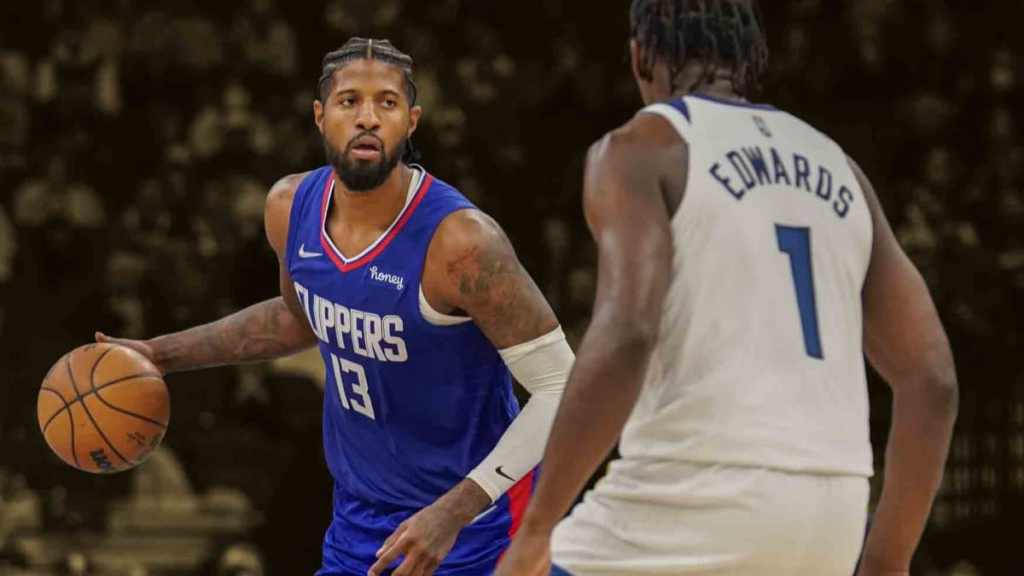
Paul George’s career has cast him as watchman over the river that delineates star from superstar, the sovereign gatekeeper between customary brilliance and everlasting legacy. To be considered definitively better than George has over the decade constituted an ironclad heuristic for diagnosing inner-circle greatness. This is no slight; merely, the NBA is at any given moment populated by a small handful of biological enigmas, evolutionary outliers beyond dear Paul whose superpowers singularly dictate the strategic landscape of their sport.
In order to discuss why this barometer has worked, PG13 is first owed a righteous defense, for he is by any measure a marvelous player. The man is the model of a modern two-way wing, a fluid navigator with disruptive length and firm contact balance whose offensive skill set matches or surpasses that of any player his size or larger in NBA history. Though not what he once was athletically, PG remains versatile and disciplined as a defender, a seamless fit in any scheme who consistently records 90th percentile impact on that end in the advanced metrics. He is an outrageously lethal shooter in all facets, cashing over 42% of his catch-and-shoot opportunities and over 35% of his threes off the dribble. For this reason, he can be downright mesmerizing with the ball in his hands, punishing defenders for closing his airspace with slithering drives and smooth finishes. His ‘bag’ is as deep as any wing in the association, with bidirectional counters at all three levels of attack, yet he retains excellent discipline in his shot selection and is thriving on a Clippers offense that primarily features him as an off-ball weapon.
Nothing in his game can be reasonably categorized as a weakness. As recently as two seasons ago, when Kawhi Leonard tore his ACL in the Western Conference Semifinals, Playoff P demonstrated that he could still shoulder the burden of being the best player on the floor. He averaged 29/10/6 in the Western Conference Finals against Phoenix, who had the five best players in the series not named Paul George, nearly taking them the distance with Reggie Jackson and Marcus Morris as his two highest scoring teammates. In 2019, he finished 3rd in MVP voting as the lightning to Russell Westbrook’s Thunder, and it is my view that his play has not deteriorated so much as adapted to fit around superior talent. Paul George would be a seamless fit on any basketball team in any era.
Unfortunately, superstardom is a referendum on exceptionality, a diploma you cannot receive by getting an A-minus in every subject. His 22-25 points per game, on efficiency that is generally two percentage points better than the league average, renders him as a 90th percentile scorer. His defensive impact, in the absence of mastodonic size or wizardlike intuition, fails to transcend above the plane of the ‘very good.’ He is an adequate passer, and a solid rebounder, but lacks a game-breaking trait, something that can’t be taken away without severe concession by the defense.
Here’s why that makes such a difference. The average half-court offense in the NBA, at least among playoff caliber teams, scores ~0.98 points per possession, the equivalent of a 49% 2-pt shot. A Paul George isolation possession, on average over the past three seasons, has been worth ~0.94 points per possession, and closer to 0.85 PPP in the postseason. Defenses are typically comfortable allowing shots of that caliber, and thus won’t bend out of position to interrupt them. Possessions in which he operates Pick & Roll score 0.95 PPP. This means that advantages frequently go ungenerated when he has the ball in his hands, as his on-ball playmaking is insufficiently dominant to command attention. He is lethal in spot-up situations, scoring closer to 1.15 points per shot, but the frequency with which the Clippers get to capitalize on that excellence is dependent on other players generating advantages such that his gravity comes into effect.
When the defense is actively scrambling, sure, the urgency to not leave *Paul George* open takes precedence over their customary rotation scheme. But it is those moments, in which the name on the back of the jersey supersedes the Xs and Os, that drive superstar-level impact in the NBA, and unfortunately they have always been too few and far between for PG13. With respect, nobody is discarding their coaching manual or lying awake in dread on the nights before facing Paul George. He falls squarely in the 16-20 range.

So, the Timberwolves have the best record in the Western Conference, and everyone is in the market for explanations. Surely, in order to win at *this* pace in a league that is eternally marketed as a battleground for cementing individual legacy, as if indifferentiable in concept from boxing or tennis, you need to have a demigod of your own, right? Anthony Edwards is dynamic, he’s charming, he takes the last shot in close games. He looks the part. For him to be the reason would be so simple.
Truthfully, he is not there yet. The Timberwolves are a gigantic, ferocious defensive juggernaut fueled by an armada of beasts with complementary skill sets. Rudy Gobert is tracking to win his fourth Defensive Player of the Year award, which would tie the most in NBA history. Both Jaden McDaniels and Nickeil Alexander-Walker are generating 95th percentile impact as defenders according to EPM, utterly smothering opposing playmakers with their 14 feet of combined wingspan. The offensive burden, for a unit that ranks 17th in the league in offensive rating, is shared between Karl Anthony-Towns, Mike Conley, and Anthony Edwards, who is the least efficient scorer of the three.
That being said, he is absolutely going to be a superstar. Edwards is only 22 years old, and already scoring 26 points per game with volume at all three levels. He is at times an overwhelming on-ball defender and a volcanic athlete whose fearlessness affords us some of the greatest highlights in all of basketball. He is marginally inefficient and a bit turnover-prone, all to be expected for a player his age, but he has a clear runway to improve. The potency of his scoring is hampered almost exclusively by an unjustified fondness for midrange jump shots, which he makes at a woeful 39% clip. Even just by cutting out the shots between 15-22 feet, the deep twos which account for almost a fifth of his shot attempts, he could supercharge his cumulative scoring impact. His turnover rate, problematically high in both isolation (11%) and Pick & Roll (15%), will improve as he ages and learns to better anticipate defensive stunts, rotation patterns, and double teams, though he likely will never be a great passer.
I am bullish on his future, as I’ve been on the Timberwolves since the end of last season, and am excited to see him get more of a national spotlight entering the playoffs, but, for now, he remains outside of my top fifteen.

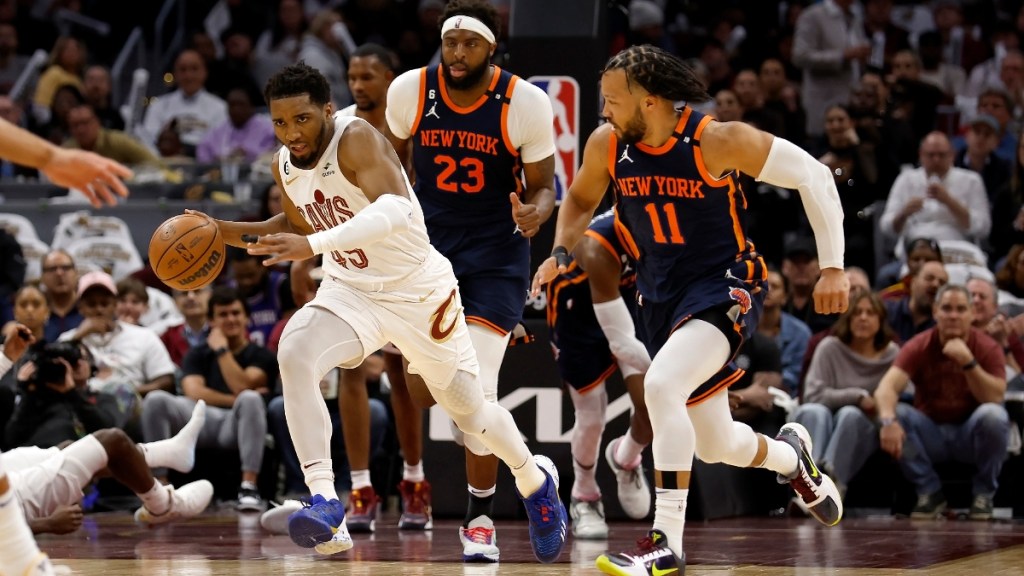
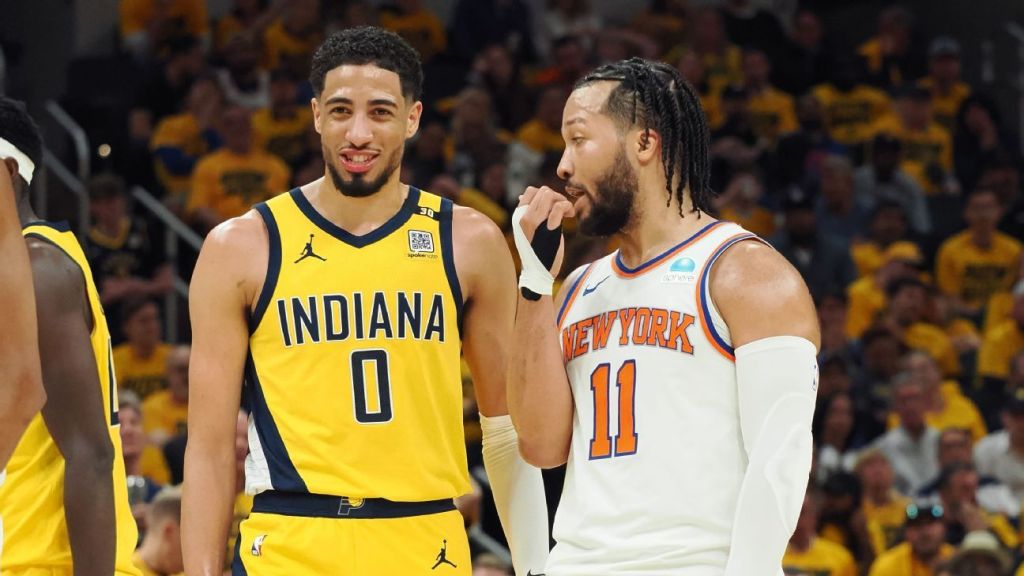
There may not be a player-team combo in the league that better compensates for each other’s weaknesses than Jalen Brunson and the New York Knicks. Without him, the Knicks operate as a haphazard collection of large bodies, a wandering flock of tubas with no conductor. Jalen fills the creation void on offense, and the Knicks wipe away his deficiencies with their defensive prowess.
The phenomenon of a perceived ‘perfect fit’ works both ways in player evaluation. Take, for example, a hypothetical team comprised of the following six players: Dennis Rodman, Matisse Thybulle, Draymond Green, Rudy Gobert, Ben Wallace, and Demar Derozan. The first five players listed, all terrific defensive players, are morbidly unskilled on the offensive end of the floor – a lineup featuring exclusively those players would be hard-pressed to score 10 points in 48 minutes against an NBA defense. Insert Demar Derozan, however, who specializes in making difficult jump shots against tight coverage, and the team begins to make a small amount of sense. He shoots 80 times per game, the team scores ~70 points, and they try to win with their all-time great defense. In this context, Demar Derozan becomes arguably the most valuable player in the league. With him off the floor, they are the worst team in the history of organized basketball. With him on the floor, the team maintains an elite defense, but scores several dozen more points per 100 possessions.
Obviously, this is an extreme example. The point remains that roster construction can maximize an individual player’s skill set to an extent that perhaps oversells that player’s greatness (or conceals their flaws) in a vacuum.
Jalen Brunson is nevertheless brilliant, and in my eyes a clear top-25 player. He is in the highest echelon of ability at both dribbling and shooting, even among the elite guards, rendering him impossible to guard one-on-one. He is in the 95th percentile of efficiency in the midrange despite taking more difficult shots in that area than nearly anyone in the league, and creates space almost entirely with abrupt deceleration rather than raw explosiveness or change in direction. Brunson lacks vertical athleticism and thus occasionally struggles to finish at the rim, but he makes up for it with monk-like balance and a tendency to stop short of the rim and shoot off two feet.
This is a drastic stylistic deviation from other high-scoring guards his size throughout recent history, but it helps the Knicks defense enormously. Players like Derrick Rose, Russell Westbrook, and Ja Morant, guards of similar stature, often finished through the charge circle, explosively and with verticality. They would dribble downhill at mach speed, then throw up a layup without slowing themselves down, meaning that their momentum would carry them out of bounds. When they missed those layups, which happened fairly often, they’d be unable to get back on defense in time to prevent a 5v4 situation. This is a defensive impact that exists beyond the box score and beyond the influence of the player’s concrete defensive talents. Likewise, even the worst defender in the league can help their defense considerably just by being present as a fifth body on the floor, as compared to only defending with four players.
As you’ll notice, Jalen Brunson’s defense still grades out as a substantial negative in most impact metrics, which gets to the core of the issue with him – he is tiny. I live in New York, and I adore the man, but basketball is played among a civilization of giants, using a hoop that is ten feet in the air. It is of course not his fault, but purely by being so often the smallest player on the court, he gives back value in subtle ways. Because he doesn’t have tremendous athleticism or jumping height, like Russ/Ja/DRose as mentioned earlier, he can’t really make up for this. He does not have access to nearly as many passing lanes as taller players, and thus struggles to maximize advantages out of blitzes or in full-speed drive and kick situations. His inability to provide any resistance against larger players, defensively, often prevents the Knicks from switching screens involving Brunson. He is a breathtaking scorer, one of the very best in the Association, but there is an inexorable degree to which every single other element of his game is hamstrung by undersizedness.
For this reason, it is difficult to see a path to improvement. For him to bridge the gap between star and superstar impact, he’d likely need to increase his scoring volume to over 30 points per game without sacrificing a morsel of efficiency, which I see as beyond his range of outcomes. Jalen Brunson falls in the 16-20 range with complete confidence for me.

Truthfully, I have been dreading this entry, for the biosphere of Damian Lillard hot takes has grown venomous. In the past month alone, I have heard that Dame is worse than Jrue Holiday, that he is the worst defender in the league, and that the Bucks would lose a first round playoff series to the Indiana Pacers.
These are indefensible, obnoxious, and fundamentally unserious statements, in precisely that order. What we are hearing is a childish overreaction to a 56 game sample size in which the Bucks have gone 35-21 while posting the 5th best offensive rating in the league. Jrue Holiday has been the single most inefficient volume scorer across each of the last three NBA postseasons – his 47.5% True Shooting not only lands him eleven percentage points below the 2021-2024 league average, it would have been a percentage point below the league average in 1961. For the Bucks to insert one of the greatest offensive players in the history of the sport (Lillard) in place of a point guard who was posting Bob Cousy numbers was a no-brainer, with due respect to Jrue Holiday’s brilliance as a perimeter defender. Dame, while limited, is nowhere close to the worst defender in the league by any metric – Defensive EPM even sees him as a slight positive. The season the Bucks won the championship, they started with the exact same record as this year’s Bucks, 35-21, coincidentally also losing their 56th game to the Memphis Grizzlies.
As recently as last season, Damian Lillard was a walking supernova. He sustained a 32 point per game scoring average at 65% True Shooting across 58 games, the second most efficient 30+ PPG season in NBA history (a fraction behind Joel Embiid’s MVP season). Following the James Harden model of analytics, Dame was attempting a comically high number of threes per game (11.3) while simultaneously generating double digit free throw attempts. He was nearly the most productive isolation scorer in the league, extracting an absurd 1.2 points per isolation possession, bolstered by a 21% rate of drawing fouls.
All of this is a preface. Suffice it to say that I am a fan of Mr Lillard’s game, and anxious to clarify that my placement of him outside the top 15 has far more to do with the players ahead of him than it does with the turbulent start to his Bucks career. He is neither ‘washed’ nor ‘fraudulent,’ and I am unwavering in my confidence that he and Giannis will form a legendary playoff duo.
Obviously, this season has not been good. The man spent a decade as the sun, the moon, and the stars for a litany of woeful Trail Blazers rosters, and is seemingly still calibrating his shot selection to the new environment. Adjusting from Jerami Grant and Rodney Hood to Giannis is understandably taking some time, and he has mentioned some heavy off-court struggles, for which I have sincere compassion.
Still, he has access to more space and more offensive talent around him than ever before, and yet he looks worse than ever. This reality must to some degree be reckoned with. Chief among a constellation of concerns has been his unrecognizably putrid three-point shooting. The back to back Starry Three Point Contest champion is shooting a galling 32% on “open” or “wide open” threes, indicating no defender within 4+ feet at the time of the shot. His isolation scoring, too, has fallen off a cliff from last season. His Free Throw rate on isolations has sustained at 20%, but when he fails to draw a foul he is scoring an appalling 0.81 points per possession.
As we discussed with Jalen Brunson, Lillard’s size dramatically limits the ways in which he can impact the game outside of scoring, so he needs to be putting the ball in the basket at an all-world level. He has done that with consistency for over a decade, but from these early returns it is fair to wonder if he is starting to slow down just a touch at 34 years old. Unlike Brunson, however, Lillard is one of several sticky cogs in the Bucks’ dysfunctional defensive machine, which leads to several more instances per game where his shortcomings are glaringly exposed.
Dame is a bona fide star, and a player I retain massive confidence in, but the league is loaded with talent and he is the last man out as he gently exits his prime.

I understand that his season averages are hardly eye-popping, so let’s ameliorate that by normalizing his minutes and slashing off the first 20 games he played. Popovich has been protecting the alien from injury, playing him just 27 minutes per game, and there was an adjustment period early in the season during which Wembanyama was forced to play Power Forward alongside Zach Collins at Center. Let’s see how those numbers look over his last 30 games, if we scale his number up to ‘Per 36 Minutes.’ He’s a 19 year old rookie on one of the worst rosters in the last decade – surely they won’t be anything we haven’t seen before, right?
Per 36 minutes: 29 points, 14 rebounds, 5 assists, 5 blocks
O_O
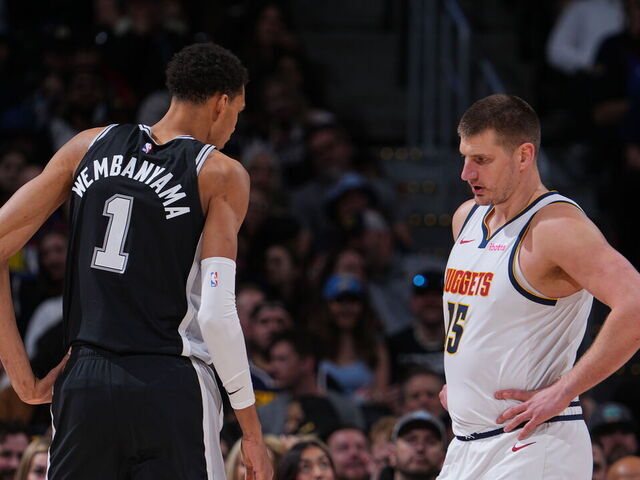
Let’s regroup. Transparently, the honorable mentions section exists almost exclusively because I had no idea what to do with Victor Wembanyama and had to discuss him somewhere. He is beyond hyperbole. To anyone who has not yet watched a Spurs game in full this season, I beseech you to do so at the earliest convenience. The sport of basketball in all of its ordinary procedure ceases to exist entirely when Victor is on the court. Typically, the progression looks something like this.
Opposing Team X enters the game with no special regard for Mr Wembanyama and his eight foot wingspan. The first couple of possessions occur with minimal hijinx, until a ball screen creates a matchup between Opposing Player A and Victor Wembanyama. Opposing Player A, with the ball in his hands, observes that Victor is standing below the free throw line, and steps into what he perceives to be a wide open three pointer. The ball meets a swift death in a gigantic French palm. Opposing Player A invariably looks around with bewilderment, occasionally turning their attention to the jumbotron. Did a fan throw something on the court? Victor Wembanyana’s sphere of influence is as of yet incomprehensible.
On the next possession, Opposing Player B finds himself in the same situation, ostensibly open for a shot with the alien lurking just beneath the free throw line, only this time he thinks better of it. Opposing Player B swings a pass in the direction of his teammate, but again a hand materializes from nothing and swallows the basketball. Victor is launching his arms around the court like detachable harpoons.
Suddenly, nothing feels safe. Opposing Team X won’t put the ball in the air within twelve feet of this human spider, lest it be ensnared in his gravitational field. The paint, in its entirety, is off-limits. Opposing Team X shoots jumper after jumper until Wembanyama mercifully exits the court, at which point they victimize the hapless non-Wembanyama Spurs en route to a comfortable victory.
What is perhaps most terrifying is that the tyranny has hardly even begun. Victor is in an experimental phase, surrounded by moribund defenders and incompetent scoring guards who couldn’t pass the green beans at a family function. He is subduing his efficiency by tinkering with different midrange fadeaways (which are going in just 32% of the time), and spending some time on defense testing out the limits of his range and explosiveness. He is already a 99th percentile impact defender, but a modicum of calibration to NBA speed, paired with the strength he will accumulate as he ages, will vault him quickly into the conversation for the best defensive player of all time. He is an 81% free throw shooter getting to the line seven times per 36 minutes as a rookie – as he familiarizes himself with the merchantry of drawing fouls, given that his shot is impossible to contest legitimately, that number is going to skyrocket towards game-breaking lunacy. The expectation, at this point, if he can stay healthy, is a prime box score average somewhere in the ballpark of 30/15/5 while dominating as the undisputed best defender in the league.
Is he already a top 15 player in the league? Frankly, the answer might be yes. For the purposes of strictly forecasting this upcoming postseason, it felt incendiary and counterproductive to include him over a player like Devin Booker. But if I could pick one player to start a franchise with, of all players in the NBA, factoring in their age and contracts and everything, I would choose Victor Wembanyama in a heartbeat.
Thanks so much for reading! I have listed some additional relevant statistics below. Part III will be coming out in the relatively near future, featuring the players ranked 12-15 on the list.
The following players were considered and will not be appearing on the list: Bam Adebayo, Jaylen Brown, De’Aaron Fox, Trae Young, James Harden, Jamal Murray, Zion Willamson, Kyrie Irving, Domantas Sabonis, Lauri Markaanen, Ja Morant, Tyrese Maxey, Julius Randle, Pascal Siakam
🙂
Paul George
2022-2023 (As of April 4th, 2023)
- 56 games played, 32-24 IN, 9-14 OUT)… 34.6 MPG, Clippers are 41-38 (preseason w/l 52.5)
- 23.8 ppg, 6.1 rpg, 5.1 apg, 3.1 TO
- 59% True Shooting… 52% from 2, 37% from 3 (7.6 per game), 87% from the line (5.3 per game)
- EPM: 4.7 (22nd), LEBRON: 3.05 (25th), RAPTOR: 5.0 (19th), (significant + on D in all metrics)
- ANALYS: 22.0
Recent Playoff Stats
- 32 game sample size from two playoff runs as a Clipper – has not played in a playoff game since 2021.
- 24.2 ppg, 8.2 rpg, 4.7 apg, 3.3 TO
- 56% True Shooting… 50% from 2, 33% from 3 (8.2 per game), 86% from the line (6.5 per game)
Anthony Edwards
2022-2023
- 79 games played (40-39 IN)… 36.0 MPG
- 24.6 ppg, 5.8 rpg, 4.4 apg, 3.3 TO
- 56% True Shooting… 51% from 2, 37% from 3 (7.3 per game), 76% from the line (5.3 per game)
- EPM: 2.3 (51st), LEBRON: 0.98 (80th), RAPTOR: 2.3 (57th)
- ANALYS: 62.67th
Recent Playoff Stats
- 11 game sample size from two playoff series as a Timberwolf
- 28.1 ppg, 4.5 rpg, 4.0 apg, 2.1 TO
- 60% True Shooting… 54% from 2, 38% from 3 (9.1 per game), 84% from the line (6.6 per game)
Jalen Brunson
2022-2023
- 68 games played (40-28 IN)… 35.0 MPG
- 24.0 ppg, 3.5 rpg, 6.2 apg, 2.1 TO
- 60% True Shooting… 52% from 2, 42% from 3 (4.7 per game), 83% from the line (5.8 per game)
- EPM: 2.1 (60th), LEBRON: 1.89 (49th), RAPTOR: 4.8 (18th)
- ANALYS: 42.33rd
Recent Playoff Stats
- 11 game sample size from two playoff series as a Knick
- 27.8 ppg, 4.9 rpg, 5.6 apg, 2.1 TO
- 59% True Shooting… 55% from 2, 33% from 3 (7.3 per game), 91% from the line (6.2 per game)
Damian Lillard
2022-2023
- 58 games played (27-31 IN)… 36.3 MPG
- 32.2 ppg, 4.8 rpg, 7.3 apg, 3.3 TO
- 65% True Shooting… 57% from 2, 37% from 3 (11.3 per game), 91% from the line (9.6 per game)
- EPM: 7.1 (3rd), LEBRON: 3.86 (15th), RAPTOR: 7.3 (5th) (big negative on D in all metrics)
- ANALYS: 7.67th
Recent Playoff Stats
- Has not been to the playoffs since 2020-2021, but here is a 26 game playoff sample from the three most recent playoff runs he had, all as a member of the Portland Trail Blazers
- 28.2 ppg, 4.5 rpg, 7.1 apg, 3.3 TO
- 60% True Shooting… 46% from 2, 40% from 3 (10.3 per game), 88% from the line (7.6 per game)
 The Crux
Leave a comment