2023-2024 NBA Player Rankings: 12-15
With the outlining of criteria and honorable mentions complete, let us dilly-dally no longer.
Welcome to the official list!
15.

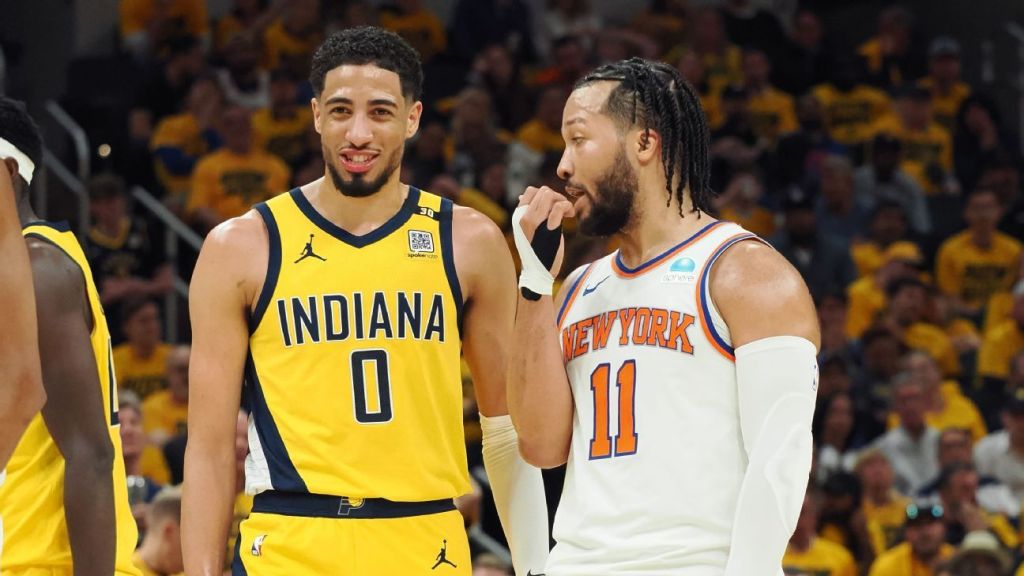
Through January 1st, 2024, the following things were true about Tyrese Haliburton.
- He was averaging 25 points per game.
- He was shooting 42% from three.
- He was averaging 13 assists per game.
- The Indiana Pacers had the best offensive rating in the history of the NBA.
On January 8th, he injured his hamstring. Shortly thereafter, the Pacers brought in Pascal Siakam and traded away Buddy Hield and Bruce Brown. The following things have been true since then.
- He is averaging 16 points per game.
- He is shooting 34% from three.
- He is averaging 9 assists per game.
- The Indiana Pacers do not have the best offensive rating in the history of the NBA .
We are left, thus, to conjecture. On the one hand, it is my inclination to attribute his regression to injury. Hamstring strains in my experience linger like mulish, sentient parasites with a dark sense of humor. To return from them is to suspend yourself in the eerie silence between hiccups, wincing and uncertain, frozen in anticipation of a pain which may never arrive.
Do I have any legitimate evidence of this? Not in the slightest. Just as well, one could argue that the league has figured him out, or that he can’t consistently generate advantages without elite shooting on all sides of him. For this reason, let’s retire the armchair detective and consult his skillset.
If there is one thing we do know, it is that Tyrese Haliburton is a passing savant. He has more games this season with twenty assists (2) than he does with more than five turnovers. No other player in the NBA has reached 20 assists in a game this season, meanwhile Luka Doncic and Nikola Jokic, the two consensus best passers in the NBA, have twenty games of 6 or more turnovers between them. Haliburton’s efficiency, if such a word may be used to describe passing, is historically unprecedented. His assist to turnover ratio of 4.78 is better than any season of Magic Johnson’s career, and nearly double the career rate of Lebron James.
Some of this is due to the smaller relative burden he shoulders as a scorer, but Tyrese is unmistakably gifted. His dribbling fluidity, supercharged by a 6’8” wingspan, renders him a threat to whip passes in any direction at a moment’s notice. Not content to merely embrace passing lanes when they arrive, Haliburton hunts them, leveraging his eyes and his speed to lure defenders away from his teammates. When he beats defenders off the dribble, rather than look for his own shot, he often barrels *toward* the closest help defender. The brilliance to this is that it entirely eliminates the cat and mouse game of help defense – by fully engaging the man in the middle, Tyrese ensures the openness of his teammate. The Pacers are the most efficient and highest scoring team in the NBA on Pick & Rolls, while also being an overwhelming offense to contain in transition. This is not a coincidence – the Pacers are lethal any time they have a numbers advantage, and Tyrese Haliburton is the reason why.
Still, there is no question he is far from a finished product as a scorer. Elite speed paired with elite shooting is a difficult combination to mess up, but Tyrese has several problematic instincts that impair his lethality as a scorer. He often shies away from contact, a trait reflected in his paltry rate of generating free throws (3.3 per game, 58th in the NBA). This aversion to getting all the way downhill makes him predictable; over 40% of his shot attempts are off-the-dribble threes, which he is converting at a measly accuracy of 34.8%. Given his speed, he would benefit enormously from better balance and deceleration, though his unorthodox shooting form may handicap his ability to develop reliable counters in the short midrange.
All told, Tyrese Haliburton is a transcendent passer and elite shooter reliably churning out efficient double-doubles as the engine of the league’s 2nd best offense, a perennial All-Star whose scoring volume and defense may be hampered for the foreseeable future by a lack of strength. He is a modern Steve Nash with superior physical tools, and I refuse to see his irradiant first half of the season as a mere flash in the pan. On a short leash, he stands in my eyes as the fifteenth best player in the NBA.
14.

Behold, the most vexatious, mystifying superstar in the National Basketball Association. Shrouded in mythology, Jimmy Butler’s resume is that of a player who has made himself impossible to evaluate. He scores less than Alperen Sengun, rebounds less than Keldon Johnson, and assists less than Caris Levert. He has yet to reach 65 games played in the regular season as a member of the Miami Heat, and the team has finished as the 5th seed or worse in the weak Eastern Conference in all but one of those seasons. He has made fewer threes in the last five seasons than Donte Divincenzo has made in this season alone, and is converting just 31% for his career in the red and black. He was the 4th highest scorer on his own team in the 2020 Eastern Conference Finals, was outscored by Bryn Forbes en route to a perfunctory exit in 2021, and was outscored by Bam Adebayo in the 2023 NBA Finals. His efficiency as a scorer since 2019 drops off by over three percentage points in the playoffs (from 61% TS -> 58% TS). He is having the worst season of his Heat career by far according to the impact metrics, which no longer paint him as a top-20 player, and, with his 35th birthday just around the corner, there is little reason to believe he’s getting better.
I would be well within reason to leave him off this list entirely.
And yet, for every blemish, there is a brilliance. The same process of cherry-picking statistics and playoff series, which above conveyed the profile of a souped-up Tobias Harris with exceptional PR, can be redeployed to make Butler look like a pantheon legend. Despite his unspectacular box score output in the regular season, Jimmy has been an advanced metrics darling. He finished 5th in the league in EPM last season (which does not include the postseason), and has been a consistent presence in the top 12 of most reputable models since joining the Miami Heat. In my estimation, this disconnect emerges from Butler’s mastery of the mundane. For one, the man simply does not turn the ball over. He finished 120th in turnovers per game last season, and is once again outside the top 100 this season. Of players scoring at least 20 PPG, he is last in turnovers per game. He remains a stalwart defender, fast enough to switch onto guards and strong enough to stand his ground against bigger forwards, and has compensated for a lack of steals this season with superior discipline away from the ball. Chief yet among the mundane, Jimmy Butler is arguably the NBA’s best con artist, by which I mean the following;
Percentage of points scored at the Free Throw Line, (minimum 20 PPG)
- 2023-2024: Jimmy Butler – 32% (1st in NBA)
- 2022-2023: Jimmy Butler – 32% (1st in NBA)
- 2021-2022: Jimmy Butler – 32% (2nd in NBA) [James Harden]
- 2020-2021: Jimmy Butler – 32% (1st in NBA)
Shelving what feelings I may have about this approach (I find it degenerate and aesthetically vomitous), getting to the free throw line is hands down the most effective method of scoring points in basketball. For Butler, a trip to the free throw line generates 1.7 expected points and affords Miami the luxury of setting up their defense on the way back, a luxury he somehow manufactures for them even more frequently in the playoffs. To defend Butler in isolation is to enter a fistfight with a master of Brazilian Jiu-Jitsu; your limbs become liabilities. He encroaches defenders slowly, assaulting their restraint with pump fakes and pivots, goading even a shadow of a hand or hip to encroach his space so that he can pounce at it for two free throws. The approach is psychologically devastating. By Game 5 last season, All-NBA defender Jrue Holiday had resorted to flat-out running away from Jimmy Butler, prepared to allow him to shoot 33 uncontested jump shots as long as it meant no more free throws.
Since the arrival of Jimmy Butler in 2020, despite having no championship to show for it, the Miami Heat have the most playoff wins of any team in the NBA (38). While some of Playoff Jimmy’s heroics have been overstated, he has lorded over the Eastern Conference like a bloodcurdling poltergeist, vanquishing the Milwaukee Bucks and Boston Celtics in four out of six playoff series despite entering as an underdog in all six matchups. He averaged 24.4 points per game on 57% True Shooting in those series, which I found surprisingly underwhelming, but, much like Lebron, Butler likes to pace himself, preserving energy and aggression for the games and moments he perceives to be of the highest leverage. Across six Game 1s, for example, he logged a thoroughly dominant 31.3 points per game, marshaling the Heat to a 5-1 record in those contests. He psychopathically dismantled the 58-win Milwaukee Bucks last season, a legendary 37.6 PPG performance featuring Butler’s magnum opus, a unilateral two-game massacre in which Playoff Jimmy poured in 98 points to overcome consecutive fifteen-point 4th quarter deficits and close out the series. I yield to the enigma. This man has thwarted my criteria and pummeled my resolve. I award him fourteenth place.
13.

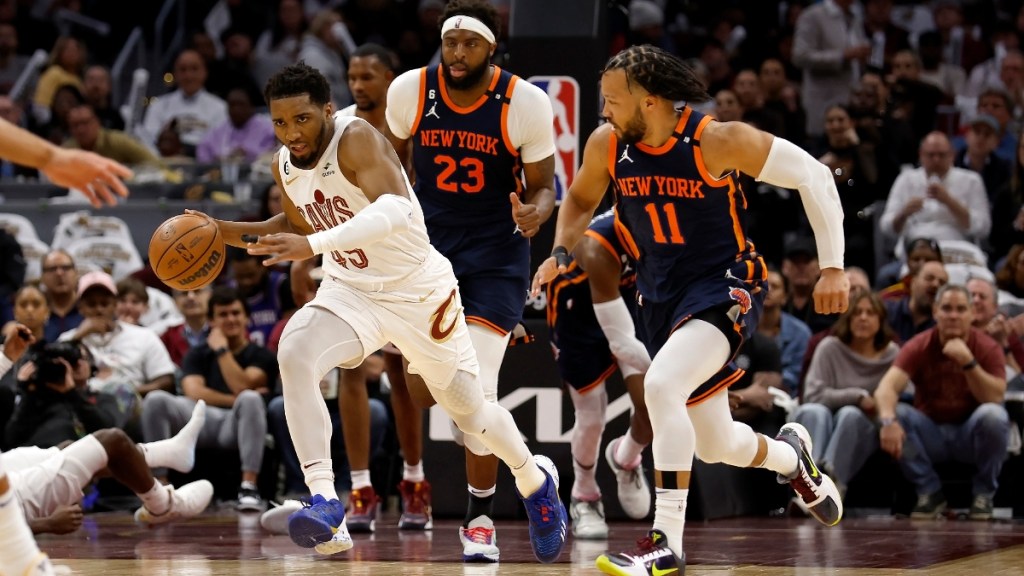
Let’s talk about what it takes to be an elite scoring guard in the modern NBA. Nicknamed ‘Spida’ for his incomprehensible 6’10” wingspan, Donovan Mitchell is 6’3” with dynamite speed and a 40-inch vertical leap, the 2018 Dunk Contest Champion despite being stronger and heavier than prime Michael Jordan (215 lbs). He shoots 10 threes per game almost exclusively off the dribble from an average distance of 26 feet and makes 40% of them. He has better handles than all but 15-20 humans who have ever lived, essentially never misses free throws, and scores more points per game than prime Dirk Nowitzki on higher efficiency (60% TS) than Shaq despite playing for an NBA team that features two non-shooting big men. He has the Assist:Turnover ratio of Larry Bird, defends like an incensed demon, and somehow improves upon all of this in the playoffs. Donovan Mitchell is staggeringly awesome.
All this, and he’s the 13th best player in the league, because the NBA is a parliament of superhuman deities. Mitchell has no discernible weakness. His shot selection is terrific, particularly given his offensive environment. He is a superlative athlete, devoted defender, and willing passer. At his size, other than become Steph Curry, there may be nothing more he can do to climb this list. The sport of basketball is played by giants on a hoop that is 10 feet off the ground. Every other player in the top twelve is at least 6’6.”
Briefly, I’ll add that I would like to see Donovan get a chance to play in a better offensive environment. He has been saddled with non-shooting big men his entire career (Gobert, Jarrett Allen) and has never played alongside another elite scorer, which I believe is costing him at least a couple of percentage points in efficiency.
12.

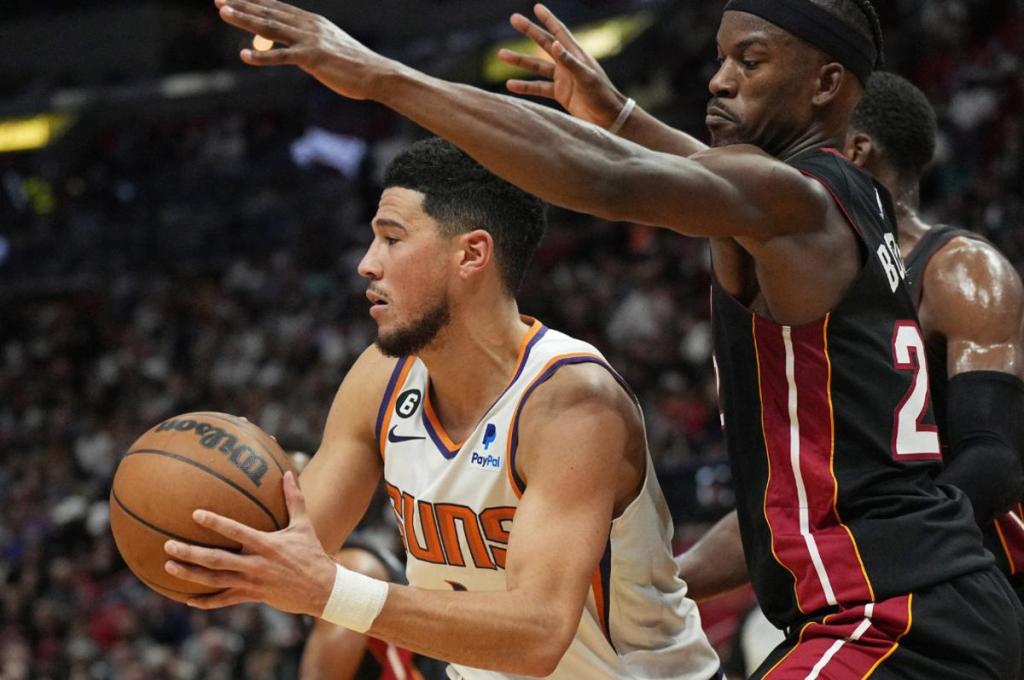
In an empty gym, would this be the most impressive player in the league? Devin Booker is exhilarating to watch. At 6’6” with shotgun handles and a bag deeper than the mantle of the earth, any shot he takes has a 40+% chance of going in. No matter how contested the shot, no matter if it is snowing in the arena, no matter if he is handcuffed and stuffed in the trunk of a police car, the threat of a bucket™ looms eternal. Nobody elicits more “That’s TUFF 😤” tweets and reactions than the Book Man. He is your favorite bucket getter’s favorite bucket getter.
Before donning my insufferable nerd goggles, I want to acknowledge that this extraordinary skill set does have a place in basketball at the highest level. With the shot clock winding down and nobody open, it is legitimately valuable to have a player who can guarantee you a 30-40% chance of scoring points. Such players considerably elevate a team’s offensive floor, more or less immunizing their teams against bad possessions. This archetype is particularly valuable on elite defensive teams that may otherwise struggle to score, like the 2001 76ers, 2009 Lakers, or 2019 Raptors.
Here is the problem – the 2024 Phoenix Suns roster is the *polar opposite* of this construct, an expressly unserious factory of redundancy that reads like it was drafted by J.R. Smith. Bradley Beal and Kevin Durant each have multiple seasons in which they scored more than 30 points per game, every role player on the team is a world class shooter, and the Suns even signed Isaiah Thomas to complete the parody of themselves. Their center is a 290 pound behemoth who has swallowed nearly 300 offensive rebounds this season and who himself has been nearly a 20 point per game scorer earlier in his career. The last thing in the world this team needs is Kobe Bryant.
Yet that is exactly what they are getting from Devin Booker, who does not treat these difficult shots like last resort, ‘get out of jail free’ cards, as he ought to. Despite the talent and spacing around him, and despite taking 84% of his shots with 8 seconds or more on the shot clock, Booker is scoring less efficiently than D’Angelo Russell over the last two seasons. It is *maddening* that a player as gifted as Booker is scoring just ONE PERCENT more efficiently than the league average. For reasons that are flatly incomprehensible, Booker is taking more shots from between 10-16 feet than he has during any other season of his career, shots which are coming at the expense of drives to the rim. He is down to just 3.8 attempts within five feet of the basket per game, which ranks 109th in the NBA, behind players like Jaime Jaquez Jr, Saddiq Bey, and Draymond Green. He is making the game significantly harder for himself than it is supposed to be for a 27+ PPG scorer.
Furthering the headache, Booker’s numbers from long range are astonishingly mediocre for a player with such pure mechanics (under 36% from three for his career). For both him and the entire Suns organization, it is at times difficult to parse whether this is an issue of aptitude or philosophy. He often appears hostile toward the arc’s existence altogether, as if the shot is an impure exploit eating away at the soul of the craft he cherishes, a temptation he must resist so as not to fall out of favor with the basketball gods. Like a prideful old man who rejects handouts, Booker has stubbornly pledged himself to the hard road.
It is only because Devin Booker is as good as he is that this is all so frustrating. He is one of the 12 best basketball players in the world despite handicapping himself. Through nine games of last year’s postseason, Booker was averaging 36 points per game on *60/50/90* shooting splits. Stretches of irradiant shotmaking like this are not uncommon for him, but the 5/22 games are inevitable as well when you consign yourself to a life of difficult, contested shots.
I am generally higher on the other aspects of Booker’s game than consensus. His passing has improved every year of his career, though he is being overburdened in his responsibilities on the Suns (who are absent a point guard). His defense has been objectively poor this season, but that has appeared to me a result of excess on-ball duties and an absurd volume of team turnovers. When the moment calls for it, barring a tendency to make mistakes away from the ball, Booker has shown an ability to play creditworthy perimeter defense. He is the rare player who I find agonizing to root both for and against. He will make a bottom-tier defense look elite with his injudicious shot diet on one night, then come back the next night and drop 40 on the league’s best defense. Take the good with the bad, and you have yourself the 12th best player in the NBA.
Thanks so much for reading! Part IV will be out soon, featuring the players ranked 7-11 on the list.
🙂
 The Crux
Leave a comment