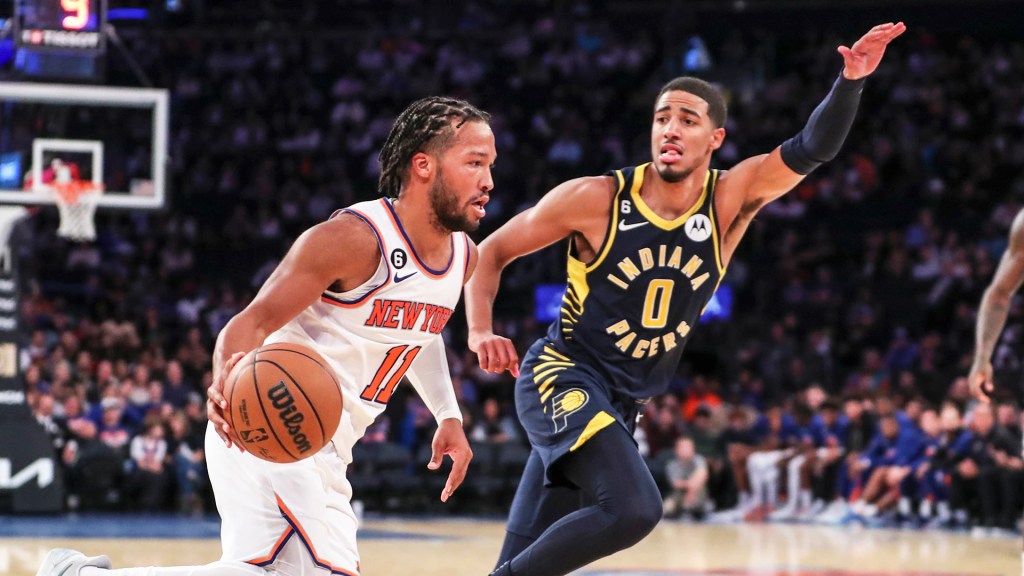
New York Knicks vs Indiana Pacers
Knicks: 50-32, 118.2 ORTG (7th), 113.4 DRTG (10th), 4.8 NET (5th)
Pacers: 47-35, 121.0 ORTG (2nd), 118.0 DRTG (24th), 3.0 NET (10th)
Season series: 2-1 IND > NYK
Game 1: Monday, 7:30 p.m. ET at Madison Square Garden (ESPN)
Seldom have the conniptions and the revelry of playoff basketball synthesized so spectacularly as to move me like a cinematic masterpiece. The New York Knicks and Philadelphia 76ers put forth an unyielding monsoon of drama, flooding its witnesses with legendary performances and unprecedented climaxes, an immortal series which imprinted its characters with inexorable tattoos of its events. Tyrese Maxey forever wears the trauma he inflicted onto Madison Square Garden in Game 5. Josh Hart, a journeyman small forward on his 4th team in seven seasons who just shot a career-low 31% from three, secured through his heroics the undying affection of a city and an eternal home for what now promises to be a lengthy, prosperous career in the NBA.
Emerging from such events, it is natural to lose perspective. The Indiana Pacers? Pfft. We already solved the whole superstar from Cameroon + guard named Tyrese thing. Light work. Knicks in five.
Upon further investigation, I must strongly advise caution. This matchup is a tactical minefield, and one the Knicks are absolutely in danger of losing. Let’s discuss.
Yet again, the Knicks are poised to dominate the rebounding battle. The Pacers finished 26th in defensive rebounding, a reflection of their youth and frailty, which ought to make them easy pickings for New York and their league-leading dominance on the offensive glass. This advantage compounds drastically if the Pacers attempt to ‘hide’ Tyrese Haliburton by assigning him to Josh Hart, who will consume Tyrese alive in pursuit of second chances.
In this case, however, there is a catch. Indiana likes to get out and RUN, sometimes risking offensive rebounds to boost their chances of generating an advantage in transition. The Knicks have to be careful when they crash the glass not to end up way behind the play, a balance which may be the defining aspect of the series. The Pacers played at the 2nd fastest pace in the league, and the Knicks played at the SLOWEST pace in the league. Not only did they play at the slowest pace, but the gap between 29th (Miami) and 30th (New York) on that list is larger than any gap between any two adjacent teams in the rankings. The Pacers were 3rd in transition frequency and took the most shots in transition of any team in the NBA (18.3), while the Knicks hover around league average in anti-transition defensive metrics.
This has a Lebron vs Golden State feeling to it, in that whichever team can impose their desired tempo onto the game will sustain an enormous advantage. The Knicks have the athletes and the collective cardio to run with Indiana, but they are riddled with injuries and emerging from a bloodbath of a series in which they played just a 7-man rotation. The issue of whether they can is thus a different one from whether they should. These players, inspiring in their relentlessness though they are, remain human, and will wear down over the course of 5-7 track meets, not to mention the kind of depleted condition they’d be in entering a potential Conference Finals matchup with the juggernaut Celtics.
In their recent playoff series, the Milwaukee Bucks (without Giannis, so perhaps the worst defensive team in the tournament) succeeded in limiting transition attempts for Indiana to some degree (13 per game), and managed to slow the game down as a whole (just 93 team possessions per game, down from Indiana’s RS average of 102). But they in turn lost the rebounding battle, which concerns me somewhat for the Knicks chances of balancing this see-saw.
The Free Throw Line is the ultimate ally to this end for the Knicks. The Indiana Pacers ranked dead-last in the NBA in opponent Free Throw rate, meaning that they fouled the most often of any team, and the Knicks get to the line with regularity (thanks both to their physicality on the interior and Jalen Brunson’s proclivity for the dark arts). The Knicks shot 24 FTA per game against Philadelphia, and, if replicated or enhanced in this series, these trips to the line will serve as speed bumps on Haliburton’s highway, affording the Knicks precious seconds to both catch their breath and set up their half-court defense.
In reviewing their half-court offense, I found that the Pacers, despite playing five-out, don’t shoot nearly as many threes (nor as efficiently from three) as you would expect. Since the All-Star Break, around which time they shipped off Buddy Hield and Bruce Brown to bring in Pascal Siakam, they are just 20th in the Association in three-point attempts and 17th in three-point accuracy. There aren’t really pressure points off of which you can overload the paint (each individual member of the starting lineup *can* shoot threes), but, with the exception of Aaron Nesmith (4.6 per game on 42%), none of them are shooting the ball at anything approaching an elite level.
Using this to transition to the players, the teams have somewhat opposite matchup advantages in this series. The Knicks have terrific options for containing the Pacers star duo; Anunoby is the Platonic ideal of a Pascal Siakam defender, and Hart/DiVo/McBride should all be able to hold up fine against a still-hobbled approximation of Tyrese Haliburton, given his limitations as a downhill scorer. They do not, on the other hand, have great answers for Myles Turner, Aaron Nesmith, or Obi Toppin, all of whom have the height to shoot over the Knicks platoon of 6’5 guards and the strength/quickness to beat them at the rim (on cuts and in transition). Myles Turner is a singularly nightmarish matchup, and perhaps the determinative series X-Factor.
Myles had a terrific season and is an underrated player in general. He is 6 ’11 ” and 250+ pounds, averaged 17 points and 7 rebounds on 63% True Shooting for the season and is one of the few true 5-out centers in the league, having led the league in blocks twice in his career while maintaining long distance accuracy above 35% on meaningful volume. He graded out as a top-50 player in the NBA this season according to EPM, above Karl Anthony-Towns, Bam Adebayo, and Zion Williamson. Turner was also arguably the most effective roll man across the Association this season, averaging 1.4 points per play (by far the most efficient of all qualifying big men) on the 5th most total possessions/attempts. The man is a problem.
In the 2 Pacers victories against New York this season, Turner averaged 25.5 points per game and 8.0 rebounds on cartoonish 88% True Shooting, which included 19/26 from the field and 8/10 from three. He played over 30 minutes in both games and committed 4 fouls in total. In the one Pacer loss, Turner got into early foul trouble and scored just 5 points in 24 minutes, failing to attempt even a single three-point shot. The Knicks will try to bring him into the action using Hartenstein screens with Brunson, in part with the goal of getting him into foul trouble, but they need to be cautious about challenging him at the summit. Pump fakes, extra passes, and floaters will be their best resources to get Myles turned around and/or off of his feet, at which point his slow-footedness can make him a liability for Indiana. On the other end, he again drags Hartenstein/Robinson away from their rim-protection duties, which exposes the Knicks to downhill drives and cuts from any of the Pacers wings/guards.
From the Pacers perspective, they have plenty of ammunition to contain the Knicks role players, but have NOTHING for Jalen Brunson. Not that anyone can stop him, but Brunson averaged over 35 points per game on 60% TS in their three *regular season* matchups. He got to the line 10 times per game.
- If you guard him with Nembhard, you are left with insufficient length to contest Jalen from behind once he comes off a screen and imprisons Nembhard behind him. This means drop coverage with Myles Turner, which Brunson will devour with utter comfort.
- If you guard him with Nesmith, you gain length but lose the quick-twitch agility required to defend without fouling, AND you sacrifice Nesmith’s rebounding, forcing the smaller Nembhard to try and stave off the blue-orange hyenas on the glass.
- If you guard him with Siakam, you both exhaust your best scorer and expose him to foul trouble without any reason to suspect tremendous results (Siakam is too slow and awkward for Brunson).
- If you guard him with Haliburton, you are a fool and belong in the circus.
I don’t think there are any magical lineups for this series. The Knicks, in my view, cannot continue to play just 7 guys. They need to find spot minutes for Achiuwa, whose switchability works well against Indiana. The Pacers will play a whole lot of Obi Toppin, otherwise futzing with the assortment of spark plugs on their 7th-10th seats. It will be a battle of principles and a war of discipline. For the Knicks, offensive rebound without compromising your transition defense, constrict passing lanes and force Haliburton to beat you as a scorer, and attack the paint without shooting driving layups. For the Pacers, DO NOT FOUL, and weaponize your spacing to target Brunson repeatedly on defense and force help.
Ultimately, I expect this series to aggravate Knicks fans enormously. The Pacers offense is built to pick apart the Knicks overzealousness, and New York is one injury away from simply forfeiting the ability to field a team. Still, Jalen Brunson and Tom Thibodeau have earned our trust.
The pick: Knicks in seven
 The Crux
Leave a comment