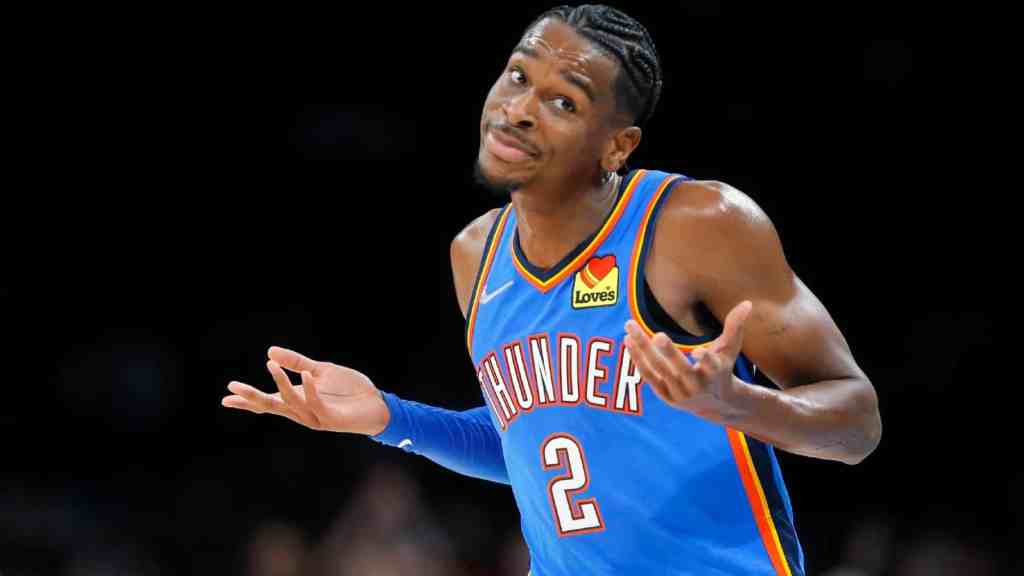
“He’s obviously the best player, but you know how it is. Voter fatigue. Shai’s had a nice season. Best player, best team, yada yada. They’ll give it to him.”
The hosts trade knowing groans and performative sighs, their eyes gently rolling as they take a moment of silence for the death of objective basketball analysis. They insist, of course, that this is no disrespect to Shai. They like Shai! It’s not his fault that Nikola Jokic exists. How is anyone supposed to compete with a 290 pound circus walrus putting up 60-point triple doubles? Jokic deserves it. Of course. But he won’t win it.
SGA’s MVP will be a ceremonial nod to fresh blood. A gold star, stickered to the top of his report card – “Good Job, Kiddo!” – for helping to lead the OKC Thunder to their best season in franchise history. He’ll win because it’s his time to win it. He will win because he was the best player not named Nikola Jokic.
This is the story you will hear, spoken with the lame confidence of a universal truth.
But what if that story is wrong? What if I told you that not only is Shai Gilgeous-Alexander going to win the 2025 MVP Award, but that he will have wholly and unreservedly earned it? That the argument for Nikola Jokic is a bloated mirage that crumbles under the same analytical scrutiny that crowned him thrice before?
It is urgent that I clarify from the outset this is not a Nikola Jokic hit piece. Jokic is in the midst of a five-year offensive peak that rivals the greatest players in the history of basketball, with his performance this season offering a worthy supplement to his argument for a seat at that goatly table. Jokic is posting career-highs in both points (29.7) and assists (10.2) per game, all the while incomprehensibly improving his efficiency, which at present hovers just south of 67% True Shooting.
Shai, meanwhile, leads the league with 32.8 points per game on 65% True Shooting. His rebounding and assist totals are modest by Jokic standards, but he makes up for much of this with an astoundingly low 8% turnover rate (compared to 13% for Nikola Jokic). He has played 74 games to Jokic’s 66, and the Oklahoma City Thunder (64-13) are over 17 games clear of the sputtering Nuggets (47-32).
Both players are having historic seasons, and a cursory glance would lead you to call it a toss-up at best for SGA. Alas, my standards are higher than cursory glancedom.
Our first order of business is that the Thunder’s effortless demolition of their opponents has directly interfered with SGA’s ability to churn out box scores that accurately reflect his brilliance. That this can be said without hyperbole is alarming, but OKC’s +13.4 net rating (tied with the ‘96 Bulls for the best mark in NBA history) undersells the efficiency with which they are trivializing their contests. They have 51 victories by double-digit margin this season, the most in NBA history, which, in concert with suspiciously middling 4th quarter metrics (17th best offense, below the Spurs, Hawks, and Bulls), helps to properly contextualize the following ludicrous stat.
- LEAGUE LEADERS IN POINTS SCORED THIS SEASON
- 1. Shai Gilgeous-Alexander (2394)
- 2. Shai Gilgeous-Alexander IN JUST THE FIRST THREE QUARTERS (2021)
- 3. Anthony Edwards (1991)
- 4. Nikola Jokic (1933)
- 5. Giannis Antetokounmpo (1882)
Nikola Jokic’s 61/10/10 game has been widely hailed as the definitive masterpiece of the season, wielded as unimpeachable evidence of his singular greatness. I submit, if I may dare, that it was not even the best game played in the month of March.
- Jokic in a 140-139 loss to the 46-33 Minnesota Timberwolves, Double Overtime
- 61 points, 10 rebounds, and 10 assists on 77% True Shooting, 4 turnovers, 5 personal fouls
- 18/29 from the field, 19/24 from the Free Throw Line
- 53 minutes played
- 61 points, 10 rebounds, and 10 assists on 77% True Shooting, 4 turnovers, 5 personal fouls
- SGA in a 137-128 win over the 52-27 Houston Rockets, in regulation
- 51 points, 5 rebounds, and 7 assists on 75% True Shooting, 2 turnovers, 1 personal foul
- 18/30 from the field, 10/10 from the Free Throw Line
- 35 minutes played
- 51 points, 5 rebounds, and 7 assists on 75% True Shooting, 2 turnovers, 1 personal foul
Normalize both of their minutes to 36, and you get the following
- Shai: 51/5/7 on 75% True Shooting in a win
- Jokic: 40/7/7 on 77% True Shooting in a loss
This is not to diminish the greatness of Nikola Jokic. It is to point out that Shai is somehow EXCEEDING it, and that we are subconsciously penalizing him for so consistently dominating his opponents such that he need not play the entire game to secure victories. SGA has routinely delivered all-time great performances this season that flew under the radar because the extent and efficiency of the obliteration he wrought rendered further stat compilation (beyond 2.5 quarters) unnecessary.
Here’s a brief list of my favorites, and the most illustrative
- 34 points (85% True Shooting) and 6 assists in 22 minutes in a blowout win vs MIL
- 50 points (73% TS), 8 rebounds, 5 assists in 33 minutes in a blowout win vs PHX
- 40 points (72% TS) and 8 assists in 29 minutes in a blowout win vs CLE
- 27 points (80% TS) and 12 assists in 27 minutes in a blowout win vs CHI
- 39 points (80% TS) in 28 minutes in a blowout win @ MSG vs the Knicks
- 35 points (81% TS), 6 rebounds, 7 assists in 28 minutes in a blowout win vs MEM
Normalize the minutes – 36 per game, average for a superstar whose team is not humiliating every single one of their opponents – and an already scintillating stretch of 37 points per game across six games ascends to a mythical 49 points per game on 80% True Shooting. The same effect is achieved by scaling Shai’s season averages to what they would be if he (34.1 mpg) played the same minutes as Nikola Jokic (36.9 per game, 5th most in the NBA).
- SGA if he played the same number of minutes as Nikola Jokic: 35.6 points per game, 5.4 rebounds per game, 7.0 assists per game, 65% True Shooting.
- Jokic if he played the same number of minutes as SGA: 27.4 points per game, 11.8 rebounds per game, 9.4 assists per game, 66% True Shooting.
You are likely to at some point encounter at least one Jokic argument that is centered around his individual net rating, otherwise known as On/Off swing, a metric which is often mistaken for a trustworthy summation of individual player impact. Jokic has been the undisputed king of On/Off for several years, with this season being no exception – the Nuggets are outscoring their opponents by 10.2 points per 100 possessions with Jokic on the floor, on par with the 60-win Boston Celtics, only to be invariably depantsed with him on the bench (-7.8 points per 100 possessions, tied with the 19-win Charlotte Hornets).
I sincerely appreciate the initial allure of this argument – I promise to deconstruct it adequately.
On/Off is, on a theoretical basis, as much a reflection on the substitute as it is on the starter. Ivica Zubac’s Clippers perform nearly 12 points per 100 possessions better with him on the floor vs off this season. Suppose, absurdly but for the sake of demonstration, that the Clippers traded their backup center in exchange for Nikola Jokic, informing Mr. Jokic that he will be playing 12 minutes per game in relief of Ivica Zubac. Consequently, Zubac sees his On/Off crater to negative 7 points per 100 possessions. Is this change any indication on Zubac’s individual quality of play?
The answer is obviously no, and the reality of Denver’s roster construction is closer to absurd than you may realize. The only non-Jokic center on the team is 37-year-old Deandre Jordan, a 41% Free Throw Shooter who navigates the court with the athleticism of a corpse being puppeteered from the arena rafters by thin string. More concerning still, his 662 mortifying minutes (-1.5 per 100 possessions) have been drastically better than the molten chaos that erupts when the Nuggets attempt to play small ball (-13.6 per 100 possessions). The difference between the Deandre Jordan Nuggets and the centerless Nuggets is larger than the difference between the Deandre Jordan Nuggets and the Nikola Jokic Nuggets. Jokic’s On/Off in 2021, his first MVP season, was +6.2 points per 100 possessions. Has he gotten three times more impactful since then? If you’re unsure, here are some illuminating On/Off splits for the 2024-2025 season that I expect will complete your radicalization against the measure.
- Lebron James: The Lakers have been 9 points per 100 possessions better with Lebron OFF the floor. They go from a .500 team with him on the floor to a juggernaut without him, at least according to +/-. Should the Lakers bench Lebron?
- Jalen Brunson: The Knicks have been 8 points per 100 possessions better with Brunson OFF the floor, improving from a slightly above .500 team to the second best team in the league. Should they be hoping Brunson stays injured going into the playoffs?
- Jayson Tatum: The Celtics improve by 3 points per 100 possessions with Tatum OFF the floor.
- Anthony Edwards: The Timberwolves improve by 3 points per 100 possessions with Anthony Edwards OFF the floor.
Variance in shooting luck and coaching philosophy help to account for aberrations of this magnitude to some degree – if you play for a coach who believes in staggering the minutes of his best players, you will naturally see a reduced On/Off footprint than you might under a coach who deploys all-bench lineups in order to maximize the time his best players can be on the floor simultaneously. Sometimes rotations are constructed such that two teammates play all of their minutes alongside one another, leaving On/Off hopeless to parse responsibility for the on-court results. Either we throw out everything we know about basketball and start from scratch, building future franchises around the titans of net rating (Cam Payne, Sam Merrill, and Luke Kornet all being players with double-digit positive net rating swings in their favor), or we recognize the stat as being too noisy to be worthwhile.
For what it’s worth (nothing), SGA’s individual net rating is as impressive as Jokic’s. The Thunder play like a 77-win team with Shai on the floor, bludgeoning opponents by a cartoonish 18 points per 100 possessions. In 800 minutes with Shai on the court and both Jalen Williams AND Chet Holmgren on the bench, the Thunder are outscoring opponents by 29 points per 100 possessions.
But we should simply not use the stat. All-in-One hybrid metrics like EPM and LEBRON, which attempt to control for these confounding variables, do a far more serious job of ranking players. Shai’s EPM of +8.9 is the fifth-highest mark recorded by a player in an individual season since 2010, bested only by 2019 Harden, 2016 Steph, 2022 Jokic, and 2010 Lebron. He is having the 7th best individual season in the history of Basketball Index’s LEBRON database, too, twelve places clear of this 2025 Nikola Jokic campaign. These are the same metrics that Jokic proponents have been citing (appropriately so!) for years as the Serbian consistently graded out in 1st place – until, of course, this year, when SGA leads every single one of them, at which point they have seemingly vanished from the discourse.
The disparity in team strength between Denver and OKC this season is enormous, but it owes entirely to the gap between their defenses. The Thunder and Nuggets share a 119.1 offensive rating, tied for third in the Association, whereas the historically oppressive Thunder defense (106.0 defensive rating) makes a laughingstock of Denver’s (115.2 defensive rating), which currently sits in 20th place, sandwiched between the Hornets and the Hawks. It is challenging to substantiate the defense conversation with numbers, as the current popular defensive statistics fall woefully short, but the gap between Shai and Jokic on this end is seismic. Shai is a strong perimeter defender, both on and off the ball, an unquestionable asset to a defense whose achievements have been chiefly catalyzed by their hyenic perimeter pressure. From November 1st to January 1st, during which time they were without both Chet Holmgren and Isaiah Hartenstein, relying on the 6’6 Jalen Williams to be their full-time starting Center, the Thunder went 23-5 and held their opponents to 103.4 points per 100 possessions. Their defense, operating with no players taller than six foot six, stifled their opponents more robustly than any team has since the 2019 Milwaukee Bucks.
Jokic, conversely, has severe mobility deficits both vertically and horizontally, and bleeds further value by virtue of occupying the center position without being a rim protector, preventing Denver from ever fielding a lineup with sufficient rim protection because they cannot play an additional center alongside him. He makes up for some of his deficiencies with instincts and positioning, but it aligns with the film (per my opinion) that this Nuggets defense is the worst of the Jokic era by a substantial margin, and a stark regression from their #8 ranked defense in 2024. EPM generously rates him as the 138th most impactful defender in the NBA, only 116 spots behind Shai Gilgeous-Alexander.
SGA is having one of the greatest scoring seasons in the history of basketball while simultaneously contributing consistently excellent defensive impact for maybe the most dominant regular season team in the history of basketball, a team that has gotten there despite being without Chet Holmgren for 76% of the season and missing 63 combined games of Isaiah Hartenstein, Jalen Williams, and Alex Caruso. Jokic’s Nuggets are currently a game out of 8th place in the Western Conference, having been unable to field a league-average defense despite having their entire rotation healthy for over 80% of the season (the exception being Aaron Gordon, who has missed 27 games, but their defensive rating is identical in the games he plays vs the games he misses this season). Shai has played 9 more games than Jokic and leads him in every advanced metric. He is going to win the 2025 NBA MVP Award.
And then he is going to win the 2025 Western Conference Finals MVP Award.
And then he is going to win the 2025 NBA Finals MVP Award.
I hope by then we can agree that he earned it all.
 The Crux
Leave a comment