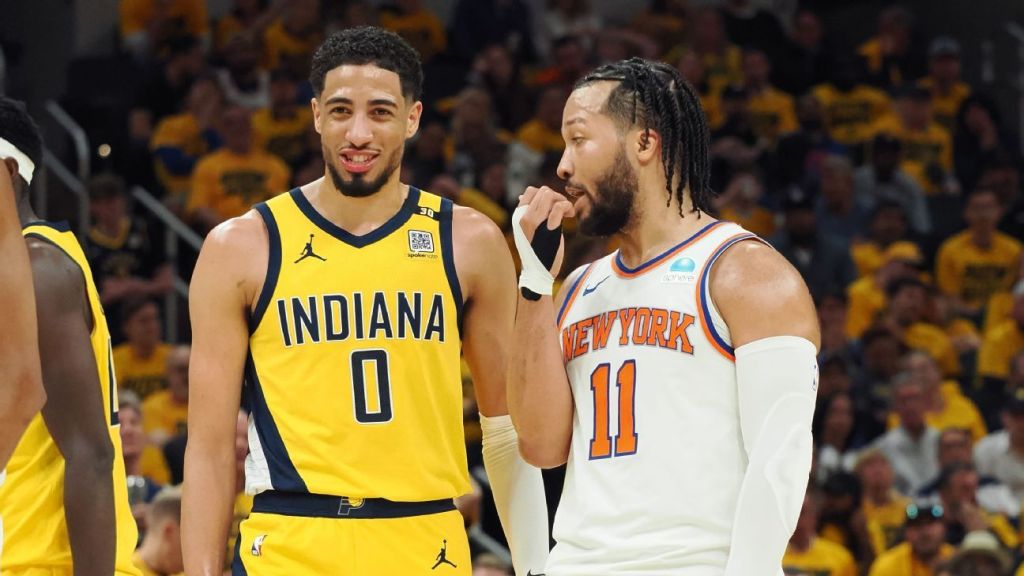
There is no time to waste – Game 1 of the NBA playoffs tips off at 1:00pm this Saturday, and, though I have never been more excited for any postseason of any year of any sports league in my life, this four day break is not nearly sufficient to rigorously analyze eight playoff series matchups! We mustn’t dilly dally with my melodramatic introductions and circuitousness. The format will be as follows: best arguments I can conjure for Team A (higher seeded), best arguments I can conjure for Team B (lower seeded), then my final verdict. Fair warning, there will be many numbers.
4. Indiana Pacers (50-32) vs 5. Milwaukee Bucks (48-34)
Indiana Pacers
- Net Rating: +2.1 (13th)
- Offensive Rating: 115.4 (9th)
- Defensive Rating: 113.3 (14th)
- 40-17 since December 6th (58-win pace)
- Net Rating: 5.2 (5th)
- Offensive Rating: 117.6 (6th)
- Defensive Rating: 112.4 (9th)
Milwaukee Bucks
- Net Rating: +2.4 (11th)
- Offensive Rating: 115.1 (10th)
- Defensive Rating: 112.7 (12th)
- Bucks without Dame: 16-8 (55-win pace)
- Net Rating: +9.3 in 916 minutes with Giannis on, Dame off
Preliminary notice: I am aware of the recent news regarding Damian Lillard’s miraculous recovery from deep vein thrombosis. I remain highly skeptical that Lillard will play in Round 1 of this series given the historical precedent for return to play from DVT, so this analysis, which had been written on the assumption of Lillard’s total absence, should remain relevant. With Lillard present and healthy, the strategic landscape of this series would shift dramatically – I cannot cover both possibilities given the time crunch.
Why the Bucks will win the series
Giannis Antetokounmpo ordinarily performs at a level on par with the twenty greatest players to ever grace the sport, but, specifically against the Indiana Pacers, he unleashes categorical armageddon. In his last ten contests vs Indiana, Giannis is averaging 37 points, 13 rebounds, and 7 assists per game on 68% from the field (133/197, 73% TS). Just for fun, I did a quick little scan of all games in which a player registered at least 30 points, 10 rebounds, and 5 assists on 60% shooting, lowering each threshold considerably for the sake of genuine investigation (not setting the minimum as his averages, don’t do that please). There have been 670 individual performances in NBA history that meet the criteria: 505 of them resulted in wins.
So, we’re off to a good start. Giannis, over a considerable sample size, has exerted an extent of statistical dominance over this opponent that, by precedent, confers a greater than 75% probability of victory. As it happens, Giannis enters this series having just put together the best month of regular season basketball he has ever played – averaging a 32 point triple double on 66% True Shooting – and the Bucks have won eight straight games.
Much of this newfound success can be attributed to the Bucks implementing a heavy dose of zone defense, a system that leverages their elite rim protection to alleviate some of the breakdowns caused by their severe lack of foot speed and agility on the perimeter. Rather surprisingly, given their impressive offensive organization and skill, the Pacers were disastrously ineffective against zone defense this season (3rd worst in the league). Upon review, what seems to be causing this is that the Pacers are a much better screening and ball movement team than they are a spot-up shooting team. A 2-3 zone which prioritizes taking away dribble penetration totally neuters the Pacers creativity, turning them into a spot-up shooting team. Though they play five out, they lack devastating individual shooters, guys with quick releases and permanent green lights. The Pacers have five guys (Haliburton, Siakam, Turner, Nesmith, Toppin) who shoot between 42-48% on ‘wide open’ threes – no defender within 6 feet – across more than sixteen such attempts per game. This is a testament to the Pacers offensive process on the whole, but is also exactly the kind of shot that zone defense eliminates. Those same five shooters, on attempts that fall into the category of ‘open’ (nearest defender 4-6 feet), converted at just a 32% rate!
The Pacers will want to try and mitigate this by playing with pace, attacking in transition (even off makes) and preventing Milwaukee from setting up their zone defense, but this is tricky if they don’t learn how to get out of their own way. The Pacers, though a solid defense overall, foul a LOT (most in the league last year, slightly better this year but still atrocious), and every pair of Bucks free throws is an opportunity for them to catch their breath and set their defense. Giannis has found his stroke of late, too, knocking down 73% of his free throw attempts this month, which would have significant implications if sustained across 12-15 nightly attempts vs Indiana.
The formula, thus, is rather simple. Giannis must be scintillatingly brilliant, and Milwaukee needs to generate a high volume of free throws in order to junk up Indiana’s offensive process with zone defense and force them into a reluctant barrage of lightly contested perimeter shots.
Why the Pacers will win the series
The Pacers are a serious team, and the Bucks are not. Since their 10-15 start to the season, the Pacers have been better than any team not located in Boston, Cleveland, or Oklahoma City. Their 40-17 record extrapolates to a near sixty-win season, a tier of contender firmly beyond Milwaukee. Tyrese Haliburton is a game-breaking offensive superstar currently in the process of annihilating every passing efficiency record (7:1 AST:TOV during this stretch!), the lead orchestrator for an offense that was the 3rd best in league history last season and which has steadily returned to that form again this season.
More pressingly, the Bucks supporting cast is an unforgivable abomination, a cupboard stocked exclusively with expired food and deadly poison. Brook Lopez, Bobby Portis, and Taurean Prince were all at some point in their careers reliable, productive players (sometimes more!), but they are a combined 100 years old. Kyle Kuzma is unironically the worst rotation player remaining across all sixteen playoff teams; he is a 29% three-point shooter and 63% free throw shooter who insists on creating his own mortifying shots off the dribble while also turning the ball over on 15% of his possessions, simultaneously serving as a 24th percentile defender per EPM because he is too slow to defend guards and too weak to defend scoring forwards and too absentminded to get deflections. Their 5th starter is Ryan Rollins, a 22 year old who weighs 175 pounds who my Dad thought was a shortstop on the Phillies. AJ Green has replaced Pat Connaughton in the rotation, but you wouldn’t know it, because when you google AJ Green on Google Images he is the third person to show up, right after the former Pro Bowl Wide Receiver for the Bengals and, you guessed it, a picture of Pat Connaughton.
It is not an exaggeration to assert that the Pacers have the 2nd, 3rd, 4th, 5th, 6th, and 7th best players in this series. They are younger, more athletic, more organized, and more skilled, without sacrificing any size or postseason experience. Even with Giannis going berserk, their last ten games against Milwaukee have been split 5-5 (average score of 128-125), and Giannis had a better supporting cast in every single one of them (including four that occurred before the Pacers’ acquisition of Pascal Siakam).
Verdict: Pacers in six (sorry Giannis)
3. New York Knicks (51-31) vs 6. Detroit Pistons (44-38)
Full Season:
New York Knicks
- Net Rating: +4.0 (8th)
- Offensive Rating: 117.3 (5th)
- Defensive Rating: 113.3 (13th)
Detroit Pistons
- Net Rating: +2.1 (12th)
- Offensive Rating: 114.6 (14th)
- Defensive Rating: 112.5 (10th)
Since January 1st:
New York Knicks
- Net Rating: +1.2 (15th)
- Offensive Rating: 115.4 (15th)
- Defensive Rating: 113.8 (16th)
Detroit Pistons
- Net Rating: +5.2 (7th)
- Offensive Rating: 116.3 (10th)
- Defensive Rating: 111.3 (5th)
Why the Pistons will win the series
The Pistons have been a flatly better team than the Knicks in all facets since the turn of the new year. Detroit went 30-19 in 2025, a four month stretch in which they played at a top 10 level on both sides of the ball while New York floundered to a pathetic +1.2 net rating, sandwiched between the Trail Blazers and Kings.
Detroit won 3 out of 4 matchups with the Knicks this season, and can easily argue that they have the best player in the series, particularly given their superstar’s success in those contests. Cade Cunningham lit the Knicks on FIRE this season, averaging 31 points and 8 assists on 67% True Shooting with just 2 turnovers per game. He is too physical for the thin frame of Mikal Bridges, too tall for Deuce McBride or Josh Hart, and too talented a shooter at every level for KAT’s drop coverage, while the Pistons’ excellent screen-setting makes it unrealistic to ask OG Anunoby to shadow him without ever switching. Both teams rely heavily on scoring at the rim (35% of their points, tied for 4th highest in the NBA), but the Pistons have elite rim protection (5th best) to the Knicks (6th worst) poor rim protection – advantage Pistons, yet again. They have the deadliest outside shooter in the series in Malik Beasley, the best perimeter defender in Ausar Thompson, the best passer in Cade Cunningham, they are younger, they are faster, and they have the better bench depth by an enormous margin. This has upset written all over it!
Why The Knicks will win the series
Alas, this is where I put to rest the “spreadsheet sycophant” allegations once and for all. I have watched over 70 Detroit Pistons games this season. I adore this team. I was one of the only pundits (lol) in the world who saw this turnaround coming (see my preseason article labeling them the most underrated team in the league, picking them to surpass even the highest alternate win total I could find) after developing a bit of an obsession with them during their historic losing streak last season. I am here to tell you that they are drawing dead to win this series.
Barring insurmountable team-wide athletic advantages or legendary individual output, postseason matchups are dictated by versatility and release valves. With weeks to acclimate to individual tendencies and several days in between games to strategize, the team that runs out of adjustments first is often the one that surrenders control of the series, and the Pistons’ Cadependency (sorry) leaves them far more susceptible to being exploited schematically. Ron Holland, Jalen Duren, Ausar Thompson, and Isaiah Stewart are all zeroes as outside shooters. Tobias Harris, Simone Fontecchio, and Dennis Schroder are nothing to be afraid of, either, knocking down a paltry 32% of their ten cumulative three-point attempts per game. Given these shooting deficits, the strategy of blitzing and overloading help defenders towards Cade feels likely to be in full effect by Game 2, rendering the Pistons at the mercy of Tobias Harris and Dennis Schroder as their only alternatives for initiating offense with the ball in their hands. When this happens, Cade is going to have to ascend to Luka Doncic-grade ingenuity as a passer to keep Detroit’s offense from stalling, which I see as exceedingly idealistic given his youth and lingering status as one of the league’s most turnover-prone players.
The Knicks, meanwhile, are for all intents and purposes “bad possession proof.” Jalen Brunson, Karl-Anthony Towns, OG Anunoby, and Mikal Bridges are all credible self-generated scorers, a skill that only increases in value with decrease in transition and overall lower scoring in the postseason. Even Deuce McBride and Josh Hart are more capable on-ball playmakers than the overwhelming majority of Detroit’s rotation, affording the Knicks a colossal stockpile of skill that insulates them against disaster on every offensive trip. This elevated strain on versatility is precisely why contending teams so covet the mystical “two-way wing,” guys you can deploy to guard any of four positions defensively who are equally comfortable playing on or off the ball (Knicks: 2, Pistons: 0).
Much has been made of how the Knicks will start the series (Anunoby on Cade vs Bridges on Cade, KAT in drop vs at the level), and I agree that it has interesting implications for Game 1, but I have little doubt that the Knicks will eventually find a successful balance. After a certain amount of the Pistons targeting Towns/Brunson defensively, the Knicks will give up on switching or drop coverage and start sending both defenders at Cade, at which point the Pistons lack of supplementary offensive skill will get exposed. The Knicks are very likely to be able to get away with playing Mitch and KAT at the same time in this series if they want to, a curveball which could shore up the Knicks rim protection woes without sacrificing much on the outside due to the plethora of poor shooters to sag off of.
Verdict: Knicks in five
2. Boston Celtics (61-21) vs 7. Orlando Magic (41-41)
Boston Celtics
- Net Rating: +9.4 (2nd)
- Offensive Rating: 119.5 (2nd)
- Defensive Rating: 110.1 (4th)
Orlando Magic
- Net Rating: -0.2 (17th)
- Offensive Rating: 108.9 (27th)
- Defensive Rating: 109.1 (2nd)
Why the Magic will win the series (I know, but let me cook)
Let’s start with a modest claim – the Orlando Magic are better than their record. Basketball Index estimates them as having lost 9.5 wins due to injury, fourth most in the NBA behind Dallas, Philadelphia, and New Orleans. Their two best players, Paolo Banchero and Franz Wagner, still just 22 and 23 years old, missed a combined 60 games, and the Magic have performed at a 50-win pace over the past two seasons with both stars on the court. Since getting both guys back in the lineup, the Magic have won 10 of their last 12 games, including wins over the Lakers, Cavs, and Pacers, with Paolo Banchero averaging 29/9/5 on 61% True Shooting (50/35/80 splits).
The Magic also have given Boston headaches in recent years, splitting their last six matchups 3-3 despite frequently nursing more injuries. They are a rare example of a team that’s actually BIGGER than the Celtics; Franz, Paolo, Jonathan Isaac, Wendell Carter Jr, and Goga Bitadze are all officially listed at six foot ten, and their mammoth lineups (even without Goga) outmenace Boston’s starting five by a combined six inches and eighty pounds on average. Orlando is the single best defense in the league at suppressing opponent three-point attempts, a strength that takes on unique importance against the team that shoots the most threes in NBA history, and one they relied on heavily in their three most recent wins over Boston (limiting them to 22% on 102 attempts). It is exceedingly rare for a 60-win team to have to play against a top-two unit in the league in Round 1, but that’s what they have in store for them against this Orlando Magic defense (108 defensive rating, 2nd best in NBA). Taking a brief look at how teams with top-two defenses have performed lately, we find four NBA champions and nineteen fifty-win teams in the last decade, with the only exception being this year’s 41-41 Orlando Magic.
Orlando plays at the slowest pace in the league, and Boston plays at the second-slowest, a stat that I reference not merely to encourage betting the under in these games – fewer possessions means increased variance! Jaylen Brown is nursing a significant knee injury after already regressing mightily this season (55% True Shooting, 32% from three, terrible advanced metrics), and 35-year-old Jrue Holiday just put together his worst season since he was a rookie (11 points and 3 assists per night on 44/35 shooting splits). You can all but pencil in Porzingis for at least one missed game this series, given that he has only played in 57% of all Celtics games since the trade in July of 2023. Is it all that far-fetched to say we are a couple of cold shooting nights from this series coming down to a Game 7 in Boston?
Why the Celtics will win the series
That is as much intrigue as I can responsibly attempt to generate for this series. The Celtics are -5000 favorites, meaning that if you bet $100 on the Celtics to win the series, and they win, you will be handsomely rewarded with 2 dollars. The case for Boston is so obvious as to not require explanation, but I’ll take care of it quickly.
The Celtics won the championship last year despite being without Porzingis for nearly their entire playoff run. He is fully healthy entering this postseason. They will have all eight of their key rotations players active for this series. They won 61 games to the Magic’s 41 and are one of just two teams (them and the Thunder) to rank top five in both Offensive and Defensive Rating.
The Magic, meanwhile, have the worst offense of any team to make the playoffs since the 2016 Atlanta Hawks. They finished a humiliating 27th in Offensive Rating and were the worst three-point shooting team in the Association by an oceanic margin. The Magic made just 31% of their threes, with more distance between them and the 29th place wizards than there is distance between any other two teams on the list, 1 through 30. They do not have a single rotation player who shot better than 34.6% from three this season (Paolo 32%, Franz 29%, KCP 34%, etc), and you have to go back to the tanking 2014 Philadelphia 76ers to find a team that made a lower percentage of their shots from the perimeter.
They are hopelessly outmatched by the Celtics, the greatest three-point shooting team of all time whose 123 points per 100 possessions last season earned them the distinction of “the single most efficient offense in NBA history.”
Verdict: Celtics in five
- Cleveland Cavaliers (64-18) vs 8. Who Cares (either the Heat or Hawks)
I’m going to copy the same blurb for both this series and the Western Conference 1 vs 8 series. I am really not a fan of these matchups going undetermined until TWO DAYS before they start. I understand the one seed should be taking care of business regardless, but they are put at a rather serious preparation disadvantage compared to the 2, 3, and 4 seeds, who all know their exact opponent a week (or at worst 5 days) in advance. The better teams often have better versatility and better coaching, which amplifies the advantage they can obtain through preparation, so it is frustrating to see that taken away from them. Both the Cavs and Thunder are going to have to start with a very vanilla, regular season game plan in their round 1 series for this reason, and, given that they will be playing exhausted teams coming off elimination games two days prior to Game 1, the product on the court is unlikely to rise in caliber from the regular season. I am also left with zero time to prepare a write up for these series – the eight seed is not determined until midnight on Friday, and the first playoff game starts at 1pm on Saturday.
Thankfully, I don’t think any of the four remaining play-in teams can give a serious challenge to the Cavs or Thunder.
Verdict: Cavs in four
ENCYCLOPEDIA OF TERMS
- Offensive Rating: Points scored per 100 possessions, used instead of points per game to account for the different pace at which teams play.
- Defensive Rating: Points allowed per 100 possessions, used instead of points allowed per game to account for the different pace at which teams play.
- True Shooting Percentage: A metric that balances 2-point field goals, 3-point field goals, and free throws to give a more accurate reflection of scoring efficiency than raw field goal percentage. 57% True Shooting is league average, and it indicates that a player scores an average of 1.14 points per scoring attempt (not including turnovers).
- EPM: https://dunksandthrees.com/about/epm refer to this fantastic explanation!
Thanks so much for reading! 🙂
 The Crux
Leave a comment