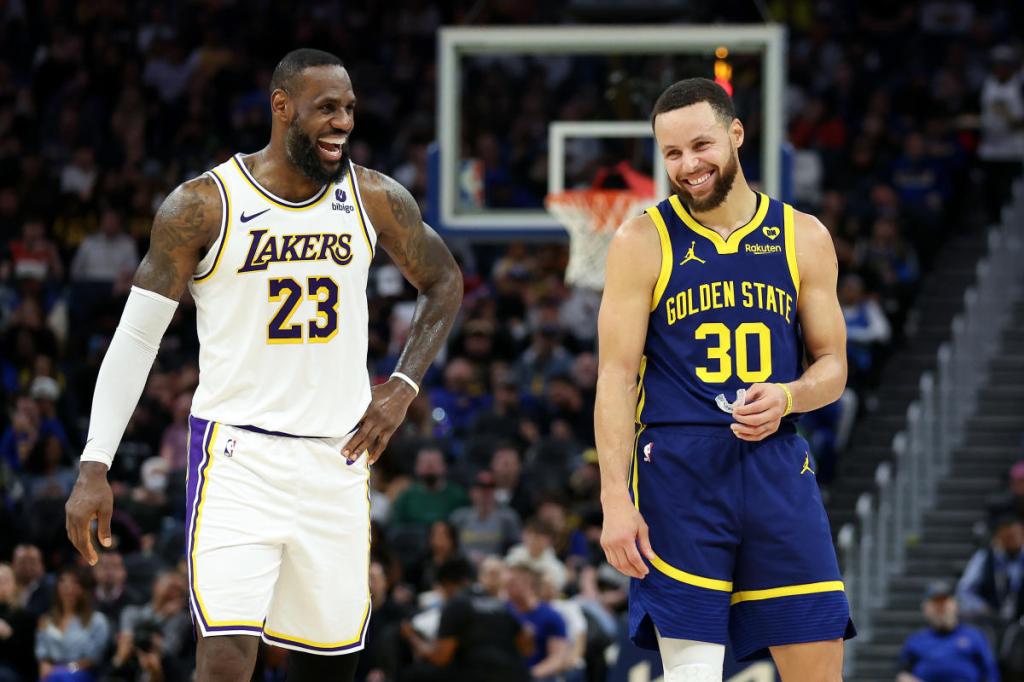
There is no time to waste – Game 1 of the NBA playoffs tips off at 1:00pm this Saturday, and, though I have never been more excited for any postseason of any year of any sports league in my life, this four day break is not nearly sufficient to rigorously analyze eight playoff series matchups! We mustn’t dilly dally with my melodramatic introductions and circuitousness. The format will be as follows: best arguments I can conjure for Team A (higher seeded), best arguments I can conjure for Team B (lower seeded), then my final verdict. Fair warning, there will be many numbers.
4. Denver Nuggets (50-32) vs 5. Los Angeles Clippers (50-32)
Denver Nuggets
- Net Rating: +3.8 (9th)
- Offensive Rating: 118.9 (4th)
- Defensive Rating: 115.1 (21st)
Los Angeles Clippers
- Net Rating: +4.9 (5th)
- Offensive Rating: 114.3 (15th)
- Defensive Rating: 109.4 (3rd)
Why the Clippers will win the series
After persevering through 3 Kawhi-less months to start the season and another two months to ramp up his workload after that, the Clippers put together the best month of basketball in the history of their franchise.
Los Angeles Clippers over their last 21 games
- Net Rating: +13.3 (1st)
- Offensive Rating: 122.2 (1st)
- Defensive Rating: 108.9 (3rd)
They won 18 of their final 21 games to surge into playoff position despite a difficult schedule featuring 17 postseason-qualifying teams, led by three All-NBA caliber players in Kawhi Leonard, James Harden, and Ivica Zubac. Kawhi’s return to form has been nothing short of awe-inspiring in light of the unrivaled catalogue of physical and emotional trauma he has endured in his career. Long since left for dead with degenerative, ligamentless knees, after being subject to yet another offseason of brazen cruelty and calls for his retirement, Kawhi Leonard just poured in two consecutive months of 27, 7, and 4 averages on 55/49/85 shooting splits (66% True Shooting) with 94th percentile defensive impact (per EPM, refer to link at the bottom of the page). 35-year-old James Harden, just recently a washed-up husk in the eyes of the broader basketball commentariat, has himself paid heed to the divine echoes stirring within him, enchanted by sultry whispers that the basketball gods are not yet finished with him. Zubac is a legitimate candidate for Defensive Player of the Year, his nightly 19 points and 13 rebounds on 67% True Shooting a mere bonus for a team that finds itself suddenly overflowing with production.
Their supporting cast, too, is robust. Kris Dunn would have been voted unanimously to 1st Team All-Defense had he met the games requirement. Norman Powell scored 25 points per game on 62% True Shooting when Kawhi missed time this season and received serious All-Star consideration at the midway point of the season. Nico Batum hit 43% of his threes and registered 90th percentile defensive impact. Derrick Jones Jr has been a ferocious defensive wing for three straight years. Bogdan Bogdanovic has hit his stride after a rough acclimation period post-trade. There are analysts who will tell you that this Clippers team has everything they need to win the championship this season.
After opening as underdogs, money has poured in on the Clippers such that they are now favored to beat the Nuggets in this opening round series. Zubac has defended Nikola Jokic better than any individual in the league since he rose to MVP form in 2021, and Zu now possesses the skill set to capitalize on Jokic’s lackluster defense. The Nuggets, who own the shameful distinction of worst defense among all teams to have made the playoffs, have the nightmarish task of defending two of the most masterful isolation scorers in league history, a problem they are going to have to hope that freshly hired David Adelman is prepared to solve after just three games of regular season coaching experience for the Denver Nuggets.
Why the Nuggets will win the series
… I just can’t bring myself to do this. I have picked these godforsaken Clippers to win the Western Conference four times in the last five seasons. Kawhi Leonard is my favorite player of all time and he has been healthy for just two of the last eight postseasons. I am too wounded. I refuse to analyze this series on the assumption that the Clippers will stay healthy.
I acknowledge that this is blatantly unprofessional. I don’t care. I am possessed by the spirit of Bartleby the Scrivener. I would prefer not to.
Despite my transparent lack of objectivity, I’ll outline why my instinct is that the Nuggets will get off on the right foot and stay there in this series.
Nikola Jokic might be the greatest offensive player in the history of the sport, and I cannot subscribe to the notion that he will meet his match in Ivica Zubac. His primary goal in Game 1 is going to be to force Zubac to abandon his duties as rim protector by setting relentless screens above the three-point line and establishing an early willingness to launch from the perimeter (he shot 45% on non-heave threes this season). From there, he is going to try and limit the extent to which the Clippers can exert their prowess as on-ball defenders, instead dissecting them from the quarterback position as his teammates sow chaos and confusion with their unceasing movement.
There have been two paths to beating the Nuggets in the Nikola Jokic era; you can play double-big lineups that shut down their interior offense and lay bare their mediocrity and reluctance as a three-point shooting team, or you can eviscerate them during the 10 minutes per game where Jokic is on the bench. The Clippers can do neither of these things. Their backup center is Ben Simmons, which, without requiring elaboration, rules out the double-big option. They also fall apart in the non-Zubac minutes to a nearly identical degree as the Nuggets do without Jokic, and, since their minutes will at best be mirrored, this totally eliminates door number two as well. The Clippers are going to have to beat the Nuggets at their own game, going punch-for-punch with the ingenious Jokic-led offense in a parallel alignment positionally. I think they are trying to do the impossible.
Verdict: Nuggets in six (it will break my heart)
3. Los Angeles Lakers (50-32) vs 6. Minnesota Timberwolves (49-33)
Los Angeles Lakers (since trading for Luka Doncic)
- Net Rating: +2.1 (15th)
- Offensive Rating: 115.7 (17th)
- Defensive Rating: 113.6 (17th)
Minnesota Timberwolves
- Net Rating: +5.0 (4th)
- Offensive Rating: 115.7 (8th)
- Defensive Rating: 110.8 (6th)
Why the Timberwolves will win the series
Each of these Western Conference series comes down to the same fundamental question – how much do you value the last two months of the season? The Clippers, Timberwolves, and Warriors have been the 3rd, 4th, and 5th best teams in basketball since the trade deadline. The Wolves are 17-3 over their last twenty games with a +12 net rating and the second-best offense in all of basketball (122 points per 100 possessions). In that same stretch of time, the Lakers were a .500 team with no ability to consistently defend. If you believe in March basketball, then you should believe that this series is going to be a massacre, in Minnesota’s favor.
In many ways, the Timberwolves have the perfect playoff roster, fit with counters for every style of fight. They have the luxury of choice at the Center position between a 4x Defensive Player of the Year in Rudy Gobert or Naz Reid, the reigning Sixth Man of the Year who is so mystifyingly fluid as a shooter and ball-handler that he earned the nickname “Big Jelly.” They can lean into oppressive length and suffocating defense with Jaden McDaniels and Nickeill Alexander-Walker on the wings, or they can favor elite spacing and shotmaking with Donte Divincenzo and Mike Conley. Edwards, Reid, and McDaniels are in their early 20s while Gobert, Randle, and Conley are in their 30s, affording the team a perfect balance of youth and experience. They can go five-out or double-big, switch everything or play drop coverage, play through the league-leading three-point shooter in Anthony Edwards (40% on 11 attempts per game) on the perimeter or bruise you with Julius Randle’s strength on the post, where he has turned himself into one of the most effective scorers in the game (1.11 points per post possession).
They were just eliminated by Luka Doncic in the Western Conference Finals last year, so the Wolves are going to be out for blood, armed with a full calendar year’s worth of rumination and revenge plotting. As I write this, I want to change my pick to the Timberwolves. They are the better team. They should absolutely feast on a Lakers defense bereft of impactful assets, and Luka the Laker has been nowhere close to the player he was last season.
Why The Lakers will win the series
Every bone in my body wants to hedge against my affection for Lebron James and pick the Lakers to lose this series. It would be so easy. Look at the numbers! Look at the defensive personnel! Listen to this quote from myself in the aftermath of the trade: “With a defense this pathetic, I would be hard-pressed to pick them in a playoff series against anyone in the Western Conference playoff picture.” (I go on to discuss why the trade was so overwhelmingly worth it regardless).
But I owe you honesty. To pick the Timberwolves in this series would consign myself to looking a coward in the mirror as I brush my teeth every morning.
This is a dream matchup for the Lakers. Their defense, which, given that they are most often playing Lebron/Rui at Center, relies on somewhat extreme help principles and a dedication to hustling their way out of 4 on 3 scrambles, is most vulnerable to skilled seven-footers and elite passers. Rudy Gobert is probably the least offensively skilled starting Center on any team in the NBA, and the Timberwolves are a mortifyingly bad passing team. Anthony Edwards is both near-sighted and color blind. Julius Randle throws more balls than strikes. Donte Divincenzo is a mortal lock to shoot the second he touches the basketball. The Lakers are going to be able to get away with all manner of foolish experiments on defense as the Timberwolves strain to isolate on Luka Doncic.
On the other end of the ball, Luka Doncic ritualistically humiliates Rudy Gobert every single time they match up. He tortured him for years in international play, he eliminated Gobert’s Jazz in 2022, and he eliminated Gobert’s Timberwolves in 2024. Nobody is better in isolation against Centers than Luka Doncic, and the Lakers five-out shooting ensures that Gobert will have nowhere to run and nowhere to hide. Lebron James will be fully healthy going into the playoffs for the first time since 2020, coming off arguably his most impactful season since 2021. Between him and JJ Redick, the Lakers have a hilarious, insurmountable advantage in basketball IQ facing a team led by Julius Randle and 23-year-old Anthony Edwards. Can the Timberwolves pose any unsolvable problems? Because if not, the Lakers will find the solutions, and I do not trust that the same can be said in reverse as the Lakers throw everything but the kitchen sink at Minnesota to test them across every schematic discipline.
Side note – is Austin Reaves the 4th best player in the series? He’s certainly played like it, averaging 23 points, 5 rebounds, and 5 assists per game on 50/41/90 splits (65% True Shooting) over his last 25 games. If he plays that way, the Timberwolves are dead on arrival.
Verdict: Lakers in seven
2. Houston Rockets (52-30) vs 7. Golden State Warriors (48-34)
Houston Rockets
- Net Rating: +4.6 (7th)
- Offensive Rating: 114.9 (12th)
- Defensive Rating: 110.3 (5th)
Golden State Warriors (since trading for Jimmy Butler)
- Net Rating: +8.9 (3rd)
- Offensive Rating: 117.7 (9th)
- Defensive Rating: 108.9 (1st)
Why the Rockets will win the series
There is no team in the Association that I believe is better equipped to defend the Warriors offense than the Houston Rockets. This, I understand, is a bold thesis, so let’s discuss what I believe are the integral challenges in defending the Warriors offense.
Problems number one, two, and three are Steph Curry. Problem number one is defending him off the ball – he is arguably the best conditioned athlete in the NBA and so absurdly gifted a shooter that you cannot allow him to ever touch the ball with more than two feet of space from the nearest defender. Problem number two is defending him on the ball – his ball handling is second only to Kyrie Irving in basketball history, he’s a 90% free throw shooter (so you can’t ever foul him), and his release is so fast that you still must abide by the two foot rule even as he navigates traffic off the dribble. Problem number three is defending everyone else on the floor given the presence of Steph Curry. It is a given that you will be playing at a numbers disadvantage (3 on 4, 2 on 3, etc) for over half of all defensive possessions when he is present.
With all this in mind, how did the Warriors finish 16th in Offensive Rating across an entire season in which Steph Curry played 70 games? Their biggest weakness, as is almost always the culprit for poor offense in the modern NBA, is a lack of shooting. Draymond Green, Jimmy Butler, Jonathan Kuminga, Gary Payton II, and Gui Santos are all players that teams are comfortable completely abandoning at the three-point line, and the Warriors will often employ as many as three of them on the court at the same time. Traditionally, the downside of this would be that it clogs the lane, an effect irrelevant to the havoc Steph wreaks from the perimeter, but teams have gotten smarter about using this condensed space to implement hybrid man-zone concepts in which two players can hound Curry while the remaining three players goose-guard the rim, daring anyone not wearing #30 to make a jump shot. The Warriors are also tiny, relying heavily on lineups in which the 6’6” Draymond Green is the tallest player on the court.
Enter Houston. Amen Thompson is the best all-around athlete in the NBA and a shoe-in for 1st Team All-Defense. He was the primary defender on Steph in their most recent (now infamous) matchup, in which Steph finished 1/9 from the field with three points and the Rockets won decisively. Dillon Brooks and Fred Vanvleet are both 90th percentile perimeter defenders themselves with extensive experience guarding Steph in the playoffs (Brooks on the Grizzlies, Vanvleet on the Raptors) to varying degrees of success. Houston’s coach, Ime Udoka, faced Steph in the finals three years ago when he was at the helm for the Boston Celtics. Steven Adams will be getting his third go at Steph in a playoff series. Point being, this is not a team that is going to be caught off-guard by him. The Curry Rules will be followed.
The Warriors’ lack of spacing is going to allow the Rockets to play Alperen Sengun and Steven Adams at the same time, if they so choose. Houston is already the best team in the league at preventing offensive rebounds, so amplifying this stranglehold on second chances could ensure that Steph never breaks free from pursuit (as he so often does in the scrambles for loose balls).
On the other end, Alperen Sengun, at 6’11” and 250 pounds with the passing vision of Trae Young, might be too tall a task for Draymond Green to handle alone. If this proves true, then the Warriors will have to sacrifice the speed and disruptiveness of either Brandin Podziemski or Moses Moody to play Quentin Post heavy minutes.
Why the Warriors will win the series
I wanted to pick Houston in 7 so badly, and I was going to, until I saw Jimmy Butler’s two most recent games – 68 points and 15 assists with 27 free throw attempts – and resigned myself to the inevitability of Playoff Jimmy.
With Jimmy averaging a measly 17 points and 5 assists across his first 28 games in blue and gold, the Golden State Warriors already looked like the third best team in basketball (refer to the numbers above). If forced to factor in a leap of any kind from Jimmy Butler, let alone one in which he nearly doubles his previous averages at the cost of no drop in efficiency, how am I to conclude they are anything less? With Jimmy amping up his aggressiveness, the Warriors get to live in the bonus, disarming any faint prayer a defense may otherwise have had of restricting Steph’s movement off the ball. They have the number one defense in basketball since acquiring Butler, a testament to his sustained excellence on that end despite age and attrition.
The Rockets’ offense is unfortunately in no condition to overcome that. They are 28th in three-point shooting volume and 21st in accuracy. They are 24th in field goal percentage inside 5 feet and 23rd in team-wide True Shooting. Not a single member of their rotation cracked 60% True Shooting this season (league average is 58%). They don’t draw fouls consistently, but when they do, they are the single least accurate free throw shooting team in the NBA.
I think Houston has the heart to make this a heart-breaker. But I don’t envision it being enough.
Verdict: Warriors in seven
- Oklahoma City Thunder (68-14) vs 8. Who Cares (either the Grizzlies or Mavs)
I’m going to copy the same blurb for both this series and the Western Conference 1 vs 8 series. I am really not a fan of these matchups going undetermined until TWO DAYS before they start. I understand the one seed should be taking care of business regardless, but they are put at a rather serious preparation disadvantage compared to the 2, 3, and 4 seeds, who all know their exact opponent a week (or at worst 5 days) in advance. The better teams often have better versatility and better coaching, which amplifies the advantage they can obtain through preparation, so it is frustrating to see that taken away from them. Both the Cavs and Thunder are going to have to start with a very vanilla, regular season game plan in their round 1 series for this reason, and, given that they will be playing exhausted teams coming off elimination games two days prior to Game 1, the product on the court is unlikely to rise in caliber from the regular season. I am also left with zero time to prepare a write up for these series – the eight seed is not determined until midnight on Friday, and the first playoff game starts at 1pm on Saturday.
Thankfully, I don’t think any of the four remaining play-in teams can give a serious challenge to the Cavs or Thunder.
Verdict: Thunder in four
ENCYCLOPEDIA OF TERMS
- Offensive Rating: Points scored per 100 possessions, used instead of points per game to account for the different pace at which teams play.
- Defensive Rating: Points allowed per 100 possessions, used instead of points allowed per game to account for the different pace at which teams play.
- True Shooting Percentage: A metric that balances 2-point field goals, 3-point field goals, and free throws to give a more accurate reflection of scoring efficiency than raw field goal percentage. 57% True Shooting is league average, and it indicates that a player scores an average of 1.14 points per scoring attempt (not including turnovers).
- EPM: https://dunksandthrees.com/about/epm refer to this fantastic explanation!
Thanks so much for reading! 🙂
 The Crux
Leave a comment